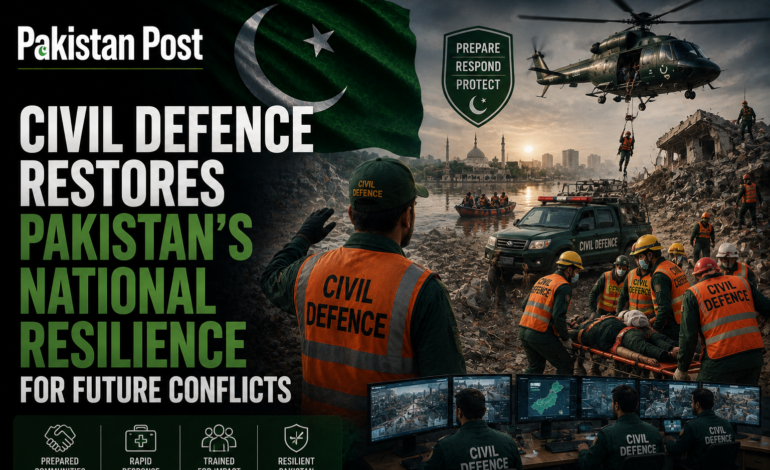
Civil Defence Restores Pakistan’s National Resilience For Future Conflicts


The geography of conflict has undergone a profound transformation. Modern warfare no longer begins with massed armour crossing borders or fighter aircraft establishing air superiority before conventional battles unfold. Instead, the earliest targets increasingly lie within the economic, administrative and technological foundations of a state itself. Electrical grids fail before military headquarters are attacked. Digital communications collapse before conventional offensives become visible. Ports, airports, logistics corridors, banking systems, water treatment facilities, hospitals, satellite communications and municipal governance are subjected to simultaneous disruption designed not merely to weaken military capability but to erode societal confidence in the state’s capacity to govern. Civilian infrastructure has become the principal theatre where strategic competition unfolds, compelling governments across the world to reconsider civil defence as an indispensable component of national security rather than an outdated relic of Cold War planning.
This evolution reflects a strategic calculation that the resilience of a nation increasingly depends upon the uninterrupted functioning of civilian institutions. Military forces may remain operational, yet prolonged interruptions in electricity, digital finance, telecommunications, transportation or emergency healthcare can generate political instability far exceeding battlefield losses. Adversaries increasingly recognise that undermining public confidence often produces greater strategic dividends than direct military confrontation. Consequently, the distinction between civilian and military domains continues to diminish as critical national infrastructure becomes inseparable from national defence.
The conflicts witnessed during the past decade illustrate this emerging reality with remarkable clarity. Missile strikes against energy generation facilities, cyber intrusions targeting financial institutions, disruption of satellite communication systems, attacks upon railway logistics, sabotage of undersea digital cables, disinformation campaigns directed at public administration and coordinated attempts to paralyse emergency response mechanisms demonstrate that contemporary strategic competition seeks systemic paralysis rather than territorial occupation alone. Hybrid warfare has matured into infrastructure warfare, where resilience determines deterrence as much as military capability.
International strategic thinking has responded accordingly. Across Europe, East Asia and North America, governments are reconstructing civil defence doctrines that integrate military planning with civilian preparedness, municipal governance, industrial continuity, technological redundancy and public participation. National resilience has become a measurable strategic asset rather than a rhetorical aspiration. Governments increasingly evaluate their security through the survivability of electricity networks, food distribution systems, fuel reserves, digital governance platforms and continuity of constitutional administration under conditions of sustained disruption.
The renewed emphasis upon resilience reflects a recognition that future conflicts will rarely provide prolonged periods for mobilisation. Strategic shocks emerge without formal declarations of war. Cyber operations can disable government databases within minutes. Artificial intelligence can amplify disinformation campaigns capable of generating social panic before official communication mechanisms respond. Autonomous systems can target transportation nodes with extraordinary precision. Economic coercion may interrupt essential imports without conventional hostilities ever materialising. Civil defence therefore extends beyond emergency shelters or wartime evacuation planning towards comprehensive governance capable of preserving national functionality during multidimensional crises.
Pakistan confronts this evolving strategic environment with both significant strengths and substantial institutional vulnerabilities. The country possesses experienced security institutions, disaster management structures, military logistical capability and considerable operational experience responding to earthquakes, floods, pandemics and internal emergencies. Nevertheless, many of these capacities remain compartmentalised rather than integrated within a unified national resilience framework. Civil defence continues to be perceived primarily through administrative regulations instead of being embedded within strategic planning across federal, provincial and municipal institutions.
The country’s expanding dependence upon digital governance further intensifies these vulnerabilities. Financial transactions increasingly rely upon interconnected digital infrastructure. Government services continue migrating towards electronic platforms. Telecommunications support economic activity across every sector. Transportation systems rely upon automated management. Energy generation depends upon digitally connected operational technologies. Such interconnectedness enhances efficiency while simultaneously expanding the attack surface available to hostile actors operating through cyber capabilities or coordinated hybrid operations.
Energy infrastructure represents one of Pakistan’s most consequential strategic vulnerabilities. Electricity generation, transmission and distribution networks underpin industrial production, healthcare delivery, communications, transportation and public administration. Disruption affecting major transmission corridors would rapidly cascade across multiple sectors, affecting banking operations, water distribution, emergency medical services and national command functions simultaneously. The resilience of energy infrastructure therefore constitutes an essential component of strategic deterrence rather than merely an economic consideration.
Similarly, digital infrastructure now represents sovereign strategic territory. Data centres, cloud computing facilities, telecommunications exchanges, satellite ground stations, fibre optic networks and governmental databases require protection equivalent to traditional defence assets. Cyber resilience cannot remain confined within technical departments because attacks increasingly seek institutional paralysis rather than technological inconvenience. National continuity increasingly depends upon the ability of civilian institutions to maintain operational capability despite sustained cyber disruption.
Transportation infrastructure deserves comparable strategic attention. Ports, airports, railways, highways and logistics hubs facilitate not only commercial activity but also military mobilisation, humanitarian assistance and governmental continuity. Their disruption would impede emergency response, economic stability and defence logistics simultaneously. Integrated resilience planning therefore requires infrastructure redundancy, rapid repair capability and coordinated operational protocols involving civilian agencies alongside military authorities.
Water security has similarly entered the strategic resilience equation. Urban water treatment facilities, reservoirs, pumping stations and distribution networks have become increasingly dependent upon digital monitoring systems vulnerable to cyber manipulation. Public health emergencies arising from water system failures could produce cascading consequences extending far beyond municipal governance. Protecting water infrastructure therefore requires combining engineering resilience with cybersecurity and emergency operational planning.
The concept of continuity of government assumes particular importance under these conditions. Modern governance cannot depend exclusively upon physical administrative buildings or centralised information systems. Essential governmental functions must remain operational despite cyber attacks, physical disruption or communication failures. This requires secure alternative communication networks, distributed data protection, succession protocols, redundant administrative facilities and regular continuity exercises involving political leadership, civil servants and security institutions.
Pakistan’s institutional arrangements possess the foundations necessary for such evolution, yet coordination remains uneven. Multiple organisations maintain responsibilities relating to disaster management, emergency response, law enforcement, public health, communications and infrastructure protection. However, these institutions frequently operate within sectoral mandates rather than an integrated resilience architecture capable of responding to simultaneous multidimensional crises. Contemporary threats demand horizontal coordination across ministries, provincial governments, municipalities, intelligence agencies, private infrastructure operators and civil society organisations.
Municipal preparedness deserves far greater strategic emphasis than it presently receives. Urban centres constitute concentrations of population, economic production, governance and infrastructure. Their resilience determines national stability during prolonged emergencies. Local governments therefore require enhanced planning capabilities regarding emergency logistics, shelter management, critical utility restoration, public health continuity, emergency communications and community mobilisation. National resilience ultimately depends upon local operational effectiveness.
Public communication has emerged as one of the decisive dimensions of strategic resilience. Information disorder frequently accompanies infrastructure disruption. False narratives can spread more rapidly than official guidance, undermining confidence precisely when governmental credibility becomes indispensable. Effective crisis communication therefore requires pre established institutional mechanisms capable of disseminating verified information rapidly across multiple communication platforms while countering coordinated disinformation operations. Strategic communication has become an operational requirement rather than a public relations function.
Civilian participation similarly requires reconsideration. Contemporary resilience cannot depend exclusively upon governmental agencies. Communities constitute the first responders during most emergencies. Volunteer networks, neighbourhood organisations, educational institutions, professional associations and private enterprises collectively determine societal adaptability during prolonged crises. Structured civic preparedness programmes therefore strengthen national resilience while reinforcing public confidence in constitutional governance.
International experience demonstrates that resilient societies invest continuously in preparedness before crises emerge. Scenario based exercises involving government departments, infrastructure operators, emergency responders and communication authorities identify institutional weaknesses before adversaries exploit them. Such exercises cultivate operational familiarity, improve decision making under uncertainty and strengthen interagency coordination. Preparedness becomes institutional culture rather than episodic administrative compliance.
Strategic reserves likewise require comprehensive reassessment. Food supplies, medical equipment, fuel reserves, telecommunications components, electrical transformers, water purification materials and digital backup systems represent strategic assets whose availability determines recovery speed following disruption. Efficient reserve management demands accurate inventory systems, diversified supply chains and distributed storage facilities capable of supporting national continuity during extended emergencies.
Private sector engagement has become indispensable because substantial portions of national infrastructure remain privately operated. Telecommunications providers, banking institutions, energy companies, logistics operators and digital service providers collectively possess capabilities central to national resilience. Public private partnerships should therefore evolve beyond commercial regulation towards shared strategic preparedness, including joint risk assessments, information sharing protocols, cybersecurity cooperation and coordinated emergency planning.
Education constitutes another overlooked dimension of civil defence modernisation. National resilience depends upon informed citizens capable of responding rationally during emergencies. Public awareness regarding emergency procedures, cyber hygiene, misinformation recognition, first aid, community coordination and infrastructure protection enhances societal adaptability while reducing panic during crises. Educational institutions can therefore become long term contributors to strategic preparedness without militarising civilian society.
Pakistan’s expanding urbanisation further reinforces the urgency of comprehensive resilience planning. Megacities concentrate demographic density alongside critical infrastructure and administrative institutions. Climate related disasters, technological accidents, cyber attacks or deliberate sabotage within such environments could generate complex cascading emergencies exceeding conventional response mechanisms. Urban resilience must therefore become an integral component of national security planning rather than solely municipal administration.
Climate change compounds these strategic considerations. Floods, heatwaves, droughts and extreme weather increasingly interact with infrastructure vulnerabilities, producing multidimensional emergencies affecting energy systems, transportation networks, agriculture, healthcare and public administration simultaneously. National resilience frameworks should therefore integrate environmental risk assessment alongside conventional security planning, recognising that climatic disruption may amplify strategic vulnerabilities exploited by hostile actors.
The establishment’s strategic community increasingly appreciates that deterrence extends beyond conventional military capability towards institutional endurance. Adversaries calculate not merely military balance but also societal resilience, governmental continuity and economic recovery capacity. States demonstrating rapid restoration of essential services reduce incentives for coercive disruption because strategic gains become difficult to sustain. Civil defence consequently contributes directly to deterrence by denial through institutional robustness.
Pakistan’s maritime infrastructure deserves particular inclusion within resilience planning. Ports facilitate international trade, energy imports and strategic logistics. Undersea communication cables connect digital commerce and governmental communications with global networks. Offshore energy facilities may acquire increasing significance as maritime development expands. Protecting these assets requires integrating naval surveillance, cybersecurity, infrastructure monitoring and emergency response planning within broader national resilience architecture.
Artificial intelligence presents both opportunities and emerging challenges for civil defence. Predictive analytics can improve disaster forecasting, infrastructure monitoring and resource allocation. Automated emergency communication systems may accelerate public warning capabilities. Simultaneously, artificial intelligence enables increasingly sophisticated cyber attacks, synthetic disinformation campaigns and autonomous targeting systems. Policy frameworks should therefore ensure responsible adoption of advanced technologies while strengthening safeguards against malicious exploitation.
Legislative modernisation remains essential. Existing legal frameworks frequently separate disaster management, cybersecurity, telecommunications regulation, infrastructure protection and emergency governance into distinct administrative domains. Contemporary strategic realities require integrated legislation establishing clear institutional responsibilities, information sharing authorities, emergency decision making procedures, infrastructure resilience standards and accountability mechanisms supporting coordinated national response.
Financial investment in resilience should be understood as strategic insurance rather than administrative expenditure. Infrastructure redundancy, cybersecurity enhancement, emergency logistics, continuity planning and public preparedness may appear costly during peacetime, yet their absence becomes exponentially more expensive during crises. National budgeting should therefore incorporate resilience indicators alongside conventional development priorities, recognising that sustainable economic growth depends upon institutional durability.
International cooperation offers valuable opportunities for strengthening domestic preparedness. Information exchange regarding critical infrastructure protection, cyber resilience, emergency management, maritime security and continuity planning can accelerate institutional learning without compromising national sovereignty. Regional cooperation concerning disaster response, telecommunications resilience and infrastructure standards similarly contributes towards broader stability across interconnected economic systems.
Pakistan’s strategic future will increasingly depend upon its capacity to preserve governmental functionality, economic continuity and societal confidence under conditions of multidimensional disruption. Military preparedness remains indispensable, yet it cannot substitute for resilient civilian institutions capable of sustaining national life throughout prolonged emergencies. The security architecture of the twenty first century demands that ministries, municipalities, utilities, telecommunications providers, educational institutions, emergency responders, intelligence organisations and citizens operate within a shared doctrine of national resilience.
Civil defence should therefore be reimagined not as a ceremonial institution associated with historical wartime planning, but as the operational foundation of modern state endurance. A National Resilience Commission reporting directly to the highest level of government could integrate strategic planning across ministries, provincial administrations and security institutions. Mandatory resilience audits for critical infrastructure, nationwide continuity of government exercises, legally protected emergency communication frameworks, resilient digital architecture, strategic reserve modernisation, municipal preparedness programmes, public volunteer corps, integrated cyber civil defence units and institutionalised public private partnerships would collectively establish a comprehensive resilience ecosystem. Such reforms would not merely improve emergency response. They would strengthen deterrence, reinforce constitutional governance, enhance investor confidence, protect strategic infrastructure and demonstrate that Pakistan possesses not only the capability to defend its borders but also the institutional endurance to preserve national cohesion against the complex spectrum of contemporary conflict.
A Public Service Message