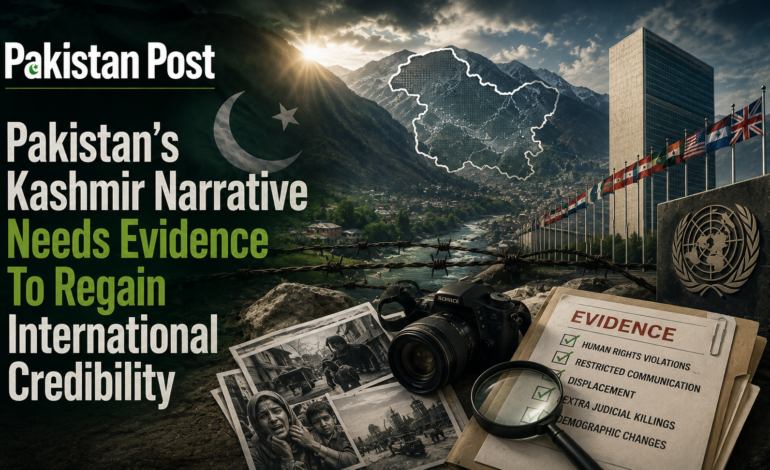
Pakistan’s Kashmir Narrative Needs Evidence To Regain International Credibility


Pakistan’s Kashmir diplomacy has a problem that cannot be solved by producing louder statements. The central weakness is not the absence of a political position, nor the lack of historical material, nor even the scarcity of international legal references. It is the uneven conversion of those assets into a sustained, independently credible body of evidence that can withstand hostile scrutiny, survive changes in media attention and remain intelligible to audiences that do not approach Kashmir through the vocabulary of South Asian strategic competition.
That distinction matters. International credibility is rarely produced by the frequency with which a government repeats its position. It is accumulated through the quality of evidence, consistency of documentation, professional conduct, legal precision and the willingness to subject one’s own claims to verification. Pakistan’s traditional Kashmir messaging has often been strongest when it has connected the dispute to documented human rights concerns, United Nations records and the principle of self determination. It becomes less persuasive when political rhetoric outruns the evidentiary record, when terminology becomes excessively securitised, or when communication appears calibrated primarily for domestic consumption.
The international environment has also changed. Kashmir is no longer interpreted principally through diplomatic communiques, parliamentary speeches and occasional newspaper editorials. It exists simultaneously within diplomatic establishments, international newsrooms, human rights networks, academic institutions, diaspora communities, short form video platforms and algorithmically mediated conversations. A claim can circulate globally within minutes, but its credibility can take years to establish. That asymmetry favours actors possessing durable documentation rather than those relying on episodic mobilisation.
The United Nations record remains an important foundation. Security Council Resolution 47 of 21 April 1948 explicitly addressed restoration of peace and order and a plebiscite in Jammu and Kashmir. The significance of such documents is not that they automatically settle every contemporary legal question, but that they provide an authoritative historical record against which subsequent arguments can be evaluated. Pakistan therefore possesses an institutional archive that should be treated as a strategic evidentiary asset rather than merely cited during moments of diplomatic pressure.
The same principle applies to human rights documentation. The Office of the United Nations High Commissioner for Human Rights published an update in July 2019 examining the human rights situation in both Indian administered Kashmir and Pakistan administered Kashmir. The report is valuable precisely because it does not fit comfortably into a purely national narrative. A professional Pakistani communication strategy should therefore resist the temptation to present international documentation selectively. Credibility is strengthened when evidence is acknowledged in its entirety, including findings that create uncomfortable questions for Islamabad.
This is where Pakistan’s Kashmir narrative requires institutional recalibration. The objective should not be to manufacture consensus. It should be to establish an evidence architecture sufficiently rigorous that international journalists, researchers, diplomats and rights organisations can independently interrogate the material and still reach defensible conclusions.
The distinction between advocacy and evidence is critical. Advocacy seeks to persuade. Evidence permits verification. A state engaged in a prolonged international dispute needs both, but they cannot be substituted for each other. A diplomatic statement can attract attention; a properly authenticated casualty record, court document, satellite image, detention record, testimony, legislative instrument or independently corroborated incident file can sustain it.
Pakistan should therefore establish a permanent Kashmir Documentation and Verification Centre operating at the intersection of diplomacy, international law, archival science, open source intelligence, human rights research and strategic communications. Its mandate should extend beyond collecting material. It should develop evidentiary standards, source classifications, chain of custody procedures, translation protocols, metadata preservation and independent peer review. Every major allegation intended for international dissemination should carry a traceable evidentiary pathway.
Such a mechanism would also address one of the most persistent vulnerabilities in contemporary conflict communication: the circulation of unverifiable digital material. Images and videos detached from their original location, date or context can rapidly become part of competing propaganda ecosystems. Once exposed as inaccurate, even unrelated evidence becomes easier for hostile audiences to dismiss. A disciplined system would therefore classify material according to evidentiary confidence, distinguish verified facts from allegations, and disclose uncertainty where verification remains incomplete.
This would represent a considerable departure from reactive communication. Pakistan’s diplomatic messaging frequently accelerates when an incident receives international attention and subsides when the news cycle moves elsewhere. That rhythm is structurally disadvantageous. International media organisations operate according to newsworthiness, while diplomatic credibility operates according to continuity. A country cannot build an enduring case by entering the conversation only after a crisis has become globally visible.
The alternative is an always on evidentiary record. A professionally maintained Kashmir database should contain incident level documentation extending across decades, with each entry linked to primary sources, corroborating testimony, relevant legislation, judicial proceedings, international reporting and geographic coordinates where appropriate. Historical records should be digitised rather than repeatedly reconstructed from press releases. Documents should be preserved in formats that allow independent researchers to inspect provenance and chronology.
The diplomatic utility of such an archive would be substantial. Pakistani missions could draw from a common repository instead of producing disconnected briefing papers. International journalists could receive source material quickly. Parliamentary delegations could be supplied with verified documentation. Researchers could access selected datasets under appropriate safeguards. Human rights organisations could examine claims without relying exclusively on government summaries. Foreign ministries would be able to respond to allegations with evidence rather than competing assertions.
The legal component requires equal professionalisation. Kashmir diplomacy is frequently compressed into a handful of political phrases, although the legal history is considerably more complicated. Pakistan’s international communication should distinguish between United Nations Security Council resolutions, bilateral agreements, customary international law, international humanitarian law, international human rights law and political commitments. Conflating these categories creates opportunities for adversaries to challenge the entire argument by attacking one legal proposition.
The principle of self determination should consequently be presented with greater doctrinal precision. International jurisprudence recognises self determination as a principle of international law, while its application depends upon the legal and factual circumstances of particular situations. Pakistan’s argument will be stronger when it explains the legal basis of its position rather than relying on declaratory terminology. International audiences, particularly legal scholars and diplomatic officials, are generally more responsive to precise claims supported by primary instruments than to maximalist formulations.
There is also a strategic requirement to broaden the vocabulary of Kashmir diplomacy. The dispute should not be communicated exclusively through the language of occupation, resistance, sovereignty and bilateral confrontation. Humanitarian protection, civilian security, freedom of expression, due process, demographic governance, access to justice, political participation, documentation, accountability and protection of cultural identity are more readily understood across international institutional environments.
That does not require abandoning Pakistan’s political position. It means translating it into internationally recognisable categories.
This is particularly important for younger global audiences. A generation encountering Kashmir through TikTok, Instagram, YouTube, podcasts and short digital explainers does not necessarily possess the historical background required to interpret diplomatic terminology. Long statements containing legal references without accessible evidence compete poorly against visually compelling narratives. Pakistan’s response should not be to imitate propaganda ecosystems. It should be to develop multilingual digital public diplomacy based on verifiable micro narratives.
A ten minute documentary showing the provenance of a documented case can be more persuasive than a hundred social media posts containing slogans. An interactive map connecting incidents to primary records can have greater strategic value than a trending hashtag. A searchable archive in English, Arabic, Urdu, Turkish, French and other relevant languages can reach audiences that conventional diplomatic communiques rarely penetrate.
Multilingualism should therefore become an operational capability rather than an occasional translation exercise. Translation must preserve legal meaning, terminology and evidentiary qualifications. A poorly translated legal claim can create diplomatic ambiguity. A professionally translated document, accompanied by its original source and verification status, creates an auditable communication trail.
Independent verification is perhaps the most difficult but potentially most transformative element. Pakistan should consider inviting respected international researchers, legal scholars, archivists, journalists and humanitarian specialists to review selected datasets under transparent procedures. The purpose would not be to outsource national policy. It would be to reduce the perception that every Pakistani source is inherently interested.
The same principle should apply to Pakistan administered Kashmir. This is strategically important. A credible international case cannot demand transparency across the Line of Control while appearing uncomfortable with scrutiny on Pakistan’s own side. International credibility is indivisible. Recent international coverage of political unrest and elections in Pakistan administered Kashmir illustrates how quickly events within Pakistan’s administered territory can become part of the wider Kashmir information contest.
For Islamabad, this creates a national security implication that extends beyond media management. Restrictions on international reporting can produce an unintended diplomatic cost because they allow opponents to argue that Pakistan applies one evidentiary standard to India and another to itself. Recent international criticism surrounding restrictions on foreign media reporting in Pakistan demonstrates how rapidly domestic information policy can become part of Pakistan’s external reputation. If Pakistan wants international scrutiny of Kashmir across the Line of Control, it has a strategic interest in demonstrating that scrutiny is not inherently threatening to the Pakistani state.
This does not mean permitting unrestricted access to sensitive security installations or compromising operational security. It means developing controlled, credible access mechanisms. Foreign journalists, researchers and humanitarian specialists could be accredited through transparent procedures, given access to designated areas and provided with official documentation while retaining the ability to report independently. The objective should be managed transparency rather than information denial.
Such an approach would also serve Pakistan’s security establishment. Strategic communication is most effective when it is integrated with national security assessment rather than treated as an afterthought of public relations. A central interagency mechanism could maintain an evidentiary matrix covering diplomatic, military, legal, humanitarian and information dimensions. Intelligence assessments could identify disinformation campaigns, but publicly released material should remain distinguishable from classified intelligence. The credibility of a public claim depends partly on whether its audience can evaluate the evidence.
Pakistan should also develop a red team capability for Kashmir communications. Before publication, major claims should be tested by analysts instructed to argue the opposing position. They should identify factual gaps, contested terminology, legal vulnerabilities, chronological inconsistencies and foreseeable media counterarguments. The purpose would not be bureaucratic caution. It would be preemptive credibility protection.
This is particularly important because India’s international communication strategy increasingly frames Kashmir through terrorism, constitutional integration, economic development and sovereignty. Pakistan cannot effectively answer this narrative by repeating its own preferred vocabulary. It must address each component with evidence. Where terrorism allegations are made, Pakistan should distinguish individual incidents, attribution standards and the legal consequences of armed violence from the broader political dispute. Where development claims are advanced, Pakistan should examine measurable indicators rather than respond with generalized accusations. Where constitutional arguments are presented, Pakistani legal specialists should engage the precise constitutional and international questions rather than treating every Indian legal assertion as self evidently illegitimate.
International journalism also rewards specificity. Reporters need names, dates, documents, locations and independently attributable sources. They are less able to work with broad claims that cannot be independently checked. Pakistan’s missions should therefore maintain specialist media desks capable of responding within hours with documentary evidence, legal references, maps, expert contacts and carefully qualified statements.
The architecture should extend beyond government. Universities, research institutes, professional associations, diaspora organisations and credible civil society bodies can contribute to a distributed knowledge ecosystem. Government should not attempt to control every voice. Indeed, excessive centralisation can undermine credibility by making the entire narrative appear manufactured. A better model is to provide access to primary documentation while allowing independent researchers to interpret it.
Pakistan Post’s policy perspective should therefore be clear. Kashmir communication is no longer merely a diplomatic messaging exercise. It is an evidentiary competition conducted simultaneously across international law, human rights institutions, journalism, academia and digital networks. The country that controls the most credible record does not automatically win the political dispute, but it possesses a strategic advantage in determining how the dispute is understood.
That advantage cannot be generated during crises. It requires institutional memory.
Pakistan should establish a permanent national Kashmir evidence registry, a multidisciplinary legal and documentation cell, an international verification advisory panel, a multilingual digital archive, an accredited research access protocol and a rapid response media unit operating from a common evidence base. These institutions should be protected from partisan turnover and supported through stable professional staffing. Their outputs should be periodically audited for factual accuracy, source integrity and legal consistency.
The strategic objective should also be reframed. The purpose of Kashmir diplomacy is not to ensure that every international audience adopts Pakistan’s position. That is neither realistic nor a useful measure of diplomatic performance. The objective should be to ensure that Pakistan’s position is treated as serious, documented, legally literate and open to scrutiny.
That distinction could materially improve Pakistan’s international standing. Diplomatic establishments do not necessarily expect disputing states to agree. They do expect them to demonstrate command of evidence. International journalists do not require governments to surrender their narratives. They require access to material that can be independently assessed. Human rights organisations do not operate primarily through geopolitical loyalty. They respond to documentation, testimony, legal standards and verifiable patterns. Younger audiences may be emotionally responsive to compelling narratives, but sustained influence increasingly depends upon whether those narratives survive fact checking.
Kashmir therefore requires less episodic rhetorical mobilisation and more institutionalised evidentiary statecraft. The strongest narrative is unlikely to be the loudest one. It will be the one that can withstand hostile examination, acknowledge uncertainty without surrendering principle, distinguish allegation from established fact and connect individual human experiences to a coherent legal and historical record.
For Pakistan, that is not merely a communications reform. It is a strategic investment in diplomatic resilience. A Kashmir narrative built on evidence can survive a changing news cycle, a changing administration in a partner country and changing digital algorithms. A narrative dependent on rhetoric cannot. The central question for Islamabad is consequently no longer whether Pakistan has a Kashmir story. It does. The strategic question is whether it has built the institutional machinery capable of proving, preserving and communicating that story to a world increasingly unwilling to accept assertion without verification.
A Public Service Message