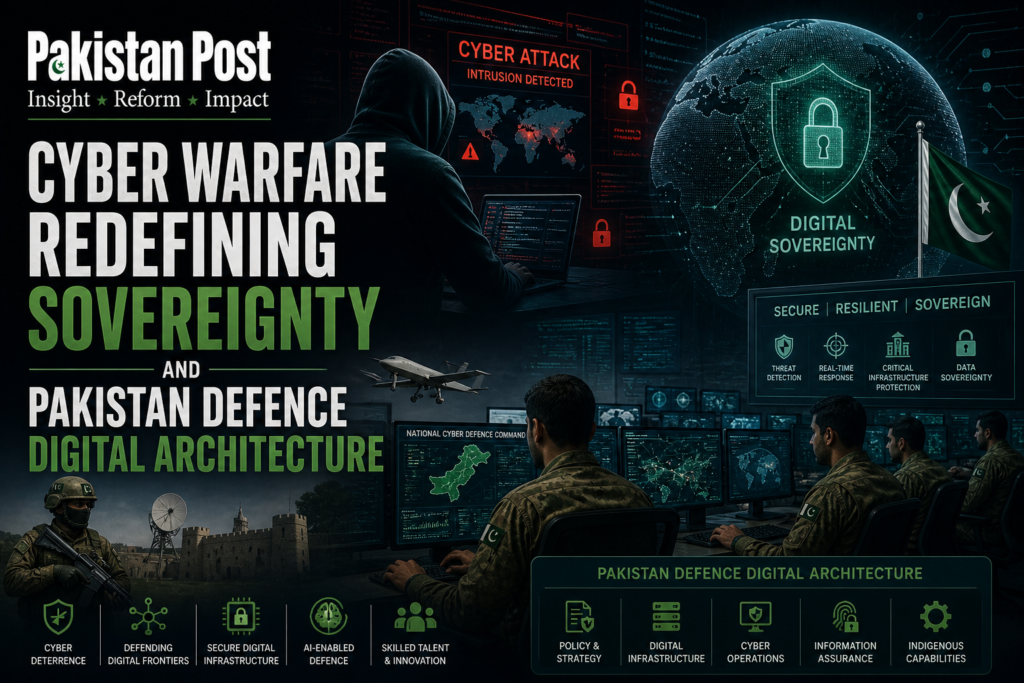
Cyber Warfare Redefining Sovereignty and Pakistan Defence Digital Architecture

Cyber warfare has moved beyond its earlier framing as an auxiliary instrument of intelligence gathering or low level disruption and has become a central arena of strategic competition among states. In the contemporary international security environment, the distinction between peace and conflict is increasingly blurred by continuous cyber operations that target critical infrastructure, financial systems, communication networks, and information ecosystems. This transformation is not episodic but structural, reflecting a shift in the ontology of warfare itself, where power is exercised through code, networks, and data flows rather than conventional force alone.
The dominant global narrative now situates cyberspace as a permanent domain of contestation. Major military doctrines, particularly those of technologically advanced states, increasingly conceptualize cyber operations as integrated components of hybrid warfare. These operations are no longer limited to sabotage or espionage but extend to cognitive influence, electoral interference, financial destabilization, and infrastructure paralysis. The convergence of artificial intelligence, big data analytics, and autonomous intrusion systems has further intensified this domain, enabling real time adaptive attacks that evolve faster than traditional defensive mechanisms can respond.
In this emerging environment, sovereignty itself is being redefined. Classical Westphalian sovereignty, grounded in territorial integrity, is insufficient to describe the vulnerabilities of states whose financial systems, energy grids, defense communications, and media ecosystems are digitally interdependent. Cyber sovereignty now refers to the ability of a state to control, protect, and govern its digital infrastructure and data ecosystems within its jurisdiction. However, this form of sovereignty is increasingly difficult to maintain in a globalized internet architecture where data flows are transnational, infrastructure is privatized, and platforms operate beyond conventional regulatory reach.
Pakistan’s cyber threat environment reflects these global dynamics in an acute form. Positioned at the intersection of geopolitical tensions, regional rivalries, and internal digital expansion, the country faces a multidimensional cyber risk matrix. Threat vectors include state sponsored intrusion attempts, ransomware targeting of public institutions, financial cybercrime networks, and disinformation campaigns that exploit social and political polarization. The increasing digitization of governance, banking, and communication systems has expanded the attack surface significantly, making cybersecurity not a peripheral concern but a core component of national security.
Institutionally, Pakistan has made partial progress in constructing a cyber defense architecture. The establishment of dedicated cybersecurity bodies, national response teams, and military cyber commands represents recognition of the domain’s strategic importance. Yet, these initiatives remain fragmented across civilian and military jurisdictions, resulting in coordination gaps and operational inefficiencies. The absence of a unified national cyber doctrine limits the ability to respond to threats in a synchronized and anticipatory manner. In contrast, leading cyber powers have integrated offensive and defensive cyber capabilities into centralized command structures with clear strategic mandates.
A key challenge lies in the asymmetry between offensive innovation and defensive preparedness. Cyber warfare inherently favors offensive actors due to the low cost of entry, anonymity, and scalability of attacks. A single vulnerability in software or network architecture can be exploited repeatedly across multiple systems. This asymmetry is further amplified by the rapid integration of artificial intelligence into cyber operations, enabling automated vulnerability scanning, adaptive malware generation, and predictive targeting of weak nodes within digital infrastructures.
Pakistan’s critical infrastructure, including energy distribution networks, telecommunications systems, financial institutions, and emerging smart city projects, is increasingly digitized. While this enhances efficiency and governance capacity, it simultaneously introduces systemic vulnerabilities. Many of these systems rely on imported technologies, proprietary software, and externally developed security protocols, creating dependencies that complicate sovereign control over cybersecurity frameworks. The risk is not only external intrusion but also supply chain vulnerabilities embedded within hardware and software ecosystems.
Globally, cyber warfare is increasingly intertwined with information warfare. Digital platforms serve as vectors for narrative construction, where public perception, political discourse, and social cohesion can be influenced through algorithmically amplified content. This fusion of cyber and cognitive warfare creates a hybrid threat environment where technical breaches and informational manipulation reinforce each other. In such a context, cybersecurity cannot be separated from media integrity and digital literacy.
Pakistan’s media environment plays a critical role in this ecosystem. The rapid expansion of social media usage has democratized information dissemination but also increased susceptibility to misinformation campaigns, coordinated influence operations, and algorithmically driven polarization. These dynamics can be exploited by external actors to shape domestic narratives, particularly during periods of political sensitivity or security crises. The resilience of cyber sovereignty therefore depends not only on technical defenses but also on informational cohesion within society.
Strategically, the evolution of missile technology and precision strike systems further intensifies the importance of cyber resilience. Modern missile systems are deeply dependent on digital command and control networks, satellite communication links, and software-based targeting systems. Any compromise in cyber infrastructure can potentially degrade or neutralize advanced kinetic capabilities. This interdependence means that cyber defense is now inseparable from conventional military deterrence. A missile system without secure cyber architecture is effectively a degraded strategic asset.
Pakistan’s defense modernization efforts increasingly reflect this reality, with growing emphasis on network centric warfare, electronic warfare capabilities, and integrated surveillance systems. However, the full integration of cyber defense into strategic doctrine remains incomplete. There is a need for doctrinal evolution that treats cyberspace not as an adjunct to traditional warfare but as an independent strategic domain with its own rules of engagement, escalation thresholds, and deterrence mechanisms.
One of the most significant gaps lies in human capital development. Cyber warfare is ultimately a contest of expertise, requiring highly skilled professionals capable of operating across multiple layers of digital systems, from network architecture to malware analysis and artificial intelligence security protocols. Pakistan’s talent base is expanding, particularly among younger populations engaged in software development and cybersecurity training programs, but institutional pathways for retaining and deploying this talent within national security frameworks remain limited.
Another critical issue is the lack of indigenous cybersecurity technologies. Dependence on foreign security software and imported defensive systems creates structural vulnerabilities, as backdoors, hidden vulnerabilities, or update dependencies can be exploited by adversarial actors. Developing domestic cybersecurity industries, including encryption technologies, intrusion detection systems, and secure communication platforms, is essential for reducing strategic exposure.
Internationally, cyber norms remain underdeveloped. Unlike nuclear deterrence, which is governed by relatively established frameworks of escalation and mutual assurance, cyber warfare operates in a largely undefined legal and ethical space. This ambiguity benefits offensive actors and complicates attribution, making retaliation and deterrence more difficult to calibrate. For Pakistan, this means operating in an environment where legal protections are weak and strategic ambiguity is high.
The economic dimension of cyber insecurity is equally significant. Cybercrime, data breaches, and system disruptions impose substantial costs on financial systems, public administration, and private sector operations. As Pakistan expands its digital economy, including fintech, e governance, and online commerce, the economic stakes of cybersecurity will increase proportionally. Trust in digital systems becomes a foundational requirement for economic growth, and any erosion of that trust can have systemic consequences.
From a policy perspective, Pakistan’s cyber strategy must evolve from reactive defense to proactive deterrence. This requires the development of real time threat intelligence systems, AI enabled anomaly detection frameworks, and integrated cyber command structures that bridge civilian and military domains. It also requires investment in resilient infrastructure design, including redundancy systems, secure cloud architectures, and localized data centres for critical national functions.
Cyber diplomacy is another emerging field of strategic importance. As cyber threats transcend borders, international cooperation becomes essential for attribution, mitigation, and norm building. Pakistan must engage actively in global cyber governance forums to shape emerging rules and protect its digital sovereignty. This includes participation in discussions on data governance, cyber warfare norms, and digital trade regulations.
The social dimension of cyber warfare cannot be overstated. The increasing dependence on digital platforms for communication, education, and governance means that cybersecurity is also a matter of social stability. Cyber disruptions can amplify public anxiety, undermine trust in institutions, and exacerbate political polarization. Strengthening cyber hygiene at the societal level through education and awareness campaigns is therefore an essential component of national resilience.
Ultimately, cyber warfare represents a fundamental shift in power. It compresses distance, accelerates conflict timelines, and dissolves traditional boundaries between civilian and military domains. For Pakistan, the challenge is not only to defend against cyber threats but to integrate cyber capabilities into a coherent national security architecture that recognizes cyberspace as a primary domain of sovereignty.
The future trajectory of cyber warfare suggests increasing automation, deeper integration with artificial intelligence, and greater convergence with physical warfare systems. States that fail to adapt to this reality risk strategic paralysis in the face of invisible but persistent threats. Pakistan’s strategic imperative is therefore clear: to transform cyber capability from a fragmented defensive concern into a central pillar of national power, embedded across governance, defense, economy, and society.
A Public Service Message