Ideological Faultlines Recast Global Governance Architecture Today

BY SHAFQAT ALI QURESHI
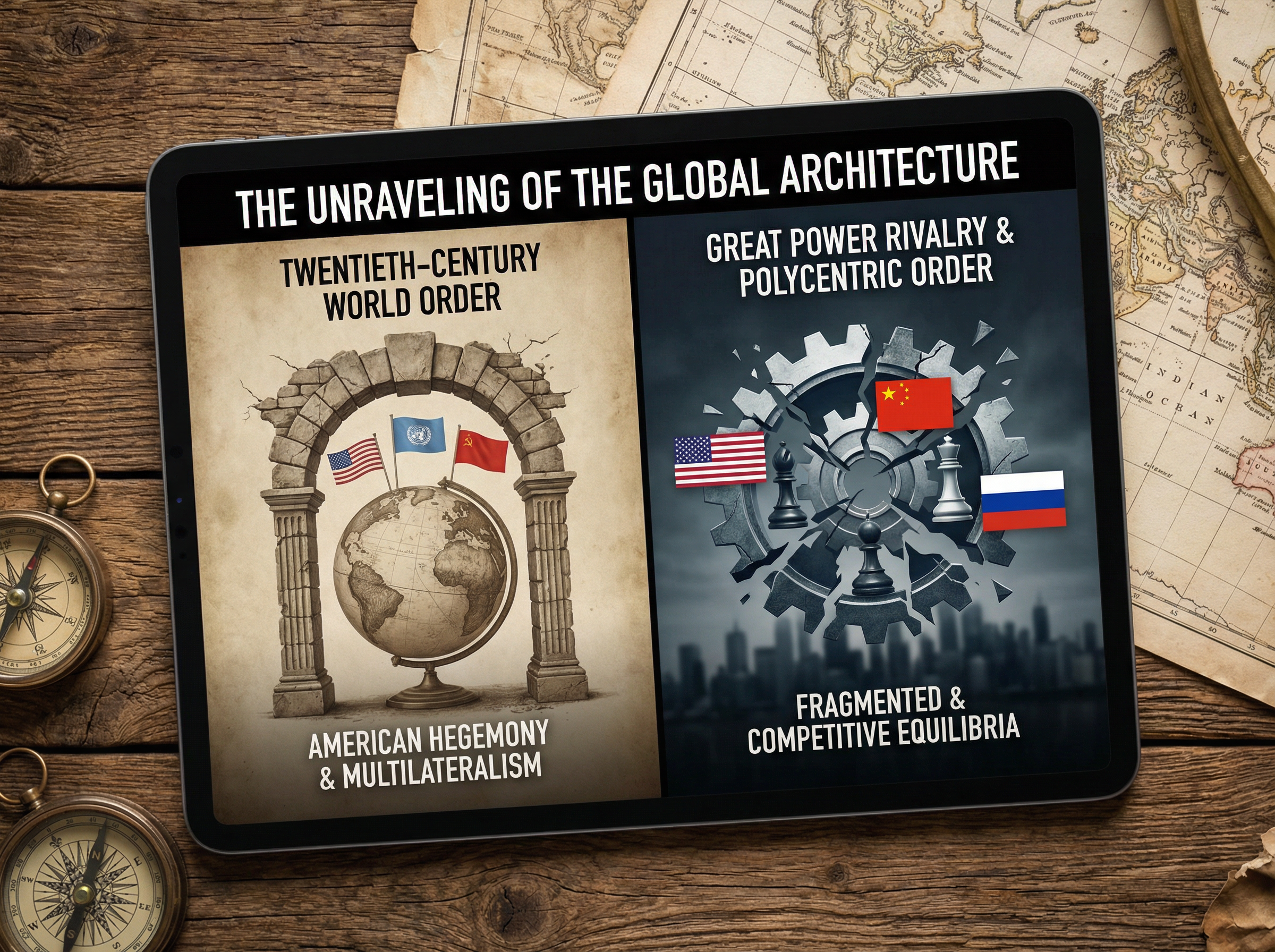
The contemporary global order is increasingly defined not by the absence of ideology, as was once assumed in the post-Cold War liberal moment, but by its intensified return in fragmented and competing forms. The assumption that globalization would converge toward a universal liberal governance model has been progressively undermined by the reassertion of alternative political systems, state centric development models, and hybrid governance structures that challenge the normative monopoly of Western institutional frameworks. What is emerging instead is a contested governance landscape in which ideology is no longer peripheral to international relations but constitutive of its structural tensions.
At the heart of this transformation lies a deepening divergence between liberal universalism and sovereignty centred governance philosophies. The liberal model, anchored in principles of democratic accountability, human rights conditionality, market-based integration, and institutional multilateralism, continues to shape the operational logic of many global institutions. Yet its universal applicability is increasingly questioned by states that prioritize stability, development sequencing, and noninterference norms over political conditionality and value-based alignment.
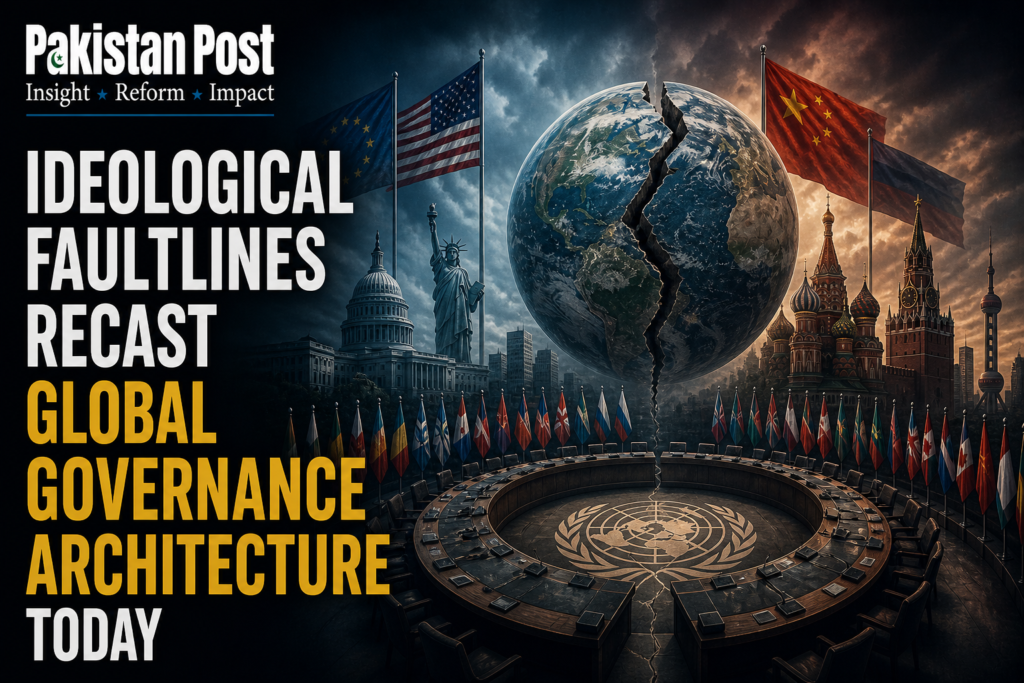
This ideological divergence is not merely theoretical. It manifests concretely in the functioning of international institutions, where consensus is increasingly difficult to achieve and where competing blocs often interpret the same norms in fundamentally different ways. The United Nations system, once envisioned as a universal platform for collective decision making, now frequently operates as a forum for structured disagreement rather than policy convergence. Voting patterns, veto usage, and parallel diplomatic initiatives reveal an underlying fragmentation of normative authority.
In parallel, new institutional architectures are emerging that reflect alternative governance philosophies. Regional development banks, connectivity driven infrastructure alliances, and non-Western multilateral platforms are expanding the institutional ecosystem beyond traditional Western dominated frameworks. These institutions often prioritize economic development, infrastructure financing, and sovereignty respect over political conditionality, thereby offering alternative pathways for engagement to states in the Global South.
Pakistan’s position within this ideological contestation is particularly instructive. Historically embedded within Western aligned security frameworks while simultaneously maintaining deep strategic and economic ties with China and broader South South cooperation networks, Pakistan occupies a hybrid ideological space. Its foreign policy narrative frequently oscillates between commitments to liberal institutional participation and assertions of sovereign equality within an unequal global system.
This duality reflects a broader structural condition faced by many developing states. Engagement with liberal institutions such as the International Monetary Fund or World Bank often requires adherence to governance reforms, fiscal restructuring, and policy conditionalities grounded in liberal economic theory. At the same time, participation in alternative institutional frameworks emphasizes infrastructural development, connectivity, and non conditional financing. The result is a dual track engagement model that reflects ideological pluralism rather than ideological consistency.
The ideological contestation is further intensified by the role of media systems in constructing global governance narratives. International media ecosystems play a critical role in shaping perceptions of legitimacy, reform, and compliance. States aligned with liberal governance models are often framed as reform oriented and institutionally credible, while those aligned with alternative models are frequently characterized through lenses of authoritarianism or state control. These narrative framings influence not only international perception but also domestic policy discourse within affected states.
In Pakistan’s case, external narratives often emphasize governance challenges, institutional fragility, or dependency on external assistance, while internal narratives tend to stress sovereignty, resilience, and strategic autonomy. This divergence between external representation and internal self-perception creates a complex communicative environment in which foreign policy is not only conducted through diplomatic channels but also through narrative contestation.
At a structural level, ideological contestation is reshaping the operational logic of global governance itself. The post-Cold War assumption of normative convergence has given way to a condition of normative pluralism, where multiple governance models coexist without hierarchical resolution. This pluralism is not necessarily stable; rather, it generates continuous friction within international institutions, as states advocate for differing interpretations of sovereignty, intervention, development, and human rights.
One of the most significant consequences of this ideological fragmentation is the weakening of enforcement capacity within global institutions. When consensus on normative principles is absent, implementation mechanisms become inconsistent. This leads to selective enforcement of rules, perceived double standards, and declining institutional legitimacy. Over time, this undermines trust in multilateral frameworks and encourages states to pursue bilateral or regional alternatives.
The ideological divide also intersects with technological governance. Emerging domains such as artificial intelligence regulation, digital sovereignty, data governance, and cyber security are becoming arenas of normative competition. Liberal governance models tend to emphasize open data flows, regulatory transparency, and private sector led innovation ecosystems. In contrast, alternative models prioritize state control over data, strategic regulation of digital infrastructure, and sovereign oversight of technological ecosystems. These differences are not merely technical but deeply ideological, reflecting divergent visions of state society relations.
For countries like Pakistan, navigating this technological ideological divide presents both opportunity and constraint. Engagement with multiple technological ecosystems can enhance access to innovation and infrastructure. However, it also requires careful management of regulatory compatibility, data governance standards, and security considerations. The absence of a unified global framework increases the complexity of integration into global digital systems.
Energy governance, climate policy, and development financing are similarly affected by ideological divergence. Climate governance frameworks often reflect tensions between historical responsibility narratives favored by liberal institutions and development centred arguments emphasized by emerging economies. Financing mechanisms for energy transition are shaped by competing priorities between market driven solutions and state led development strategies. Pakistan, as a climate vulnerable developing economy, is directly impacted by these competing governance logics.
At the geopolitical level, ideological contestation reinforces broader patterns of strategic alignment. States increasingly align not only based on material interests but also on governance philosophies. This does not result in rigid bloc formation but rather in flexible alignments across different issue areas. A state may cooperate with liberal institutions in financial governance while aligning with alternative frameworks in infrastructure development or security cooperation. This issue-based alignment reflects the complexity of contemporary ideological politics.
The persistence of ideological contestation also challenges the concept of a unified international order. Rather than a single coherent system, what exists is a layered and partially overlapping set of governance regimes. These regimes differ in normative foundations, enforcement mechanisms, and institutional practices. The result is a condition of institutional fragmentation rather than systemic coherence.
Pakistan’s foreign policy narrative must therefore operate within this fragmented ideological environment. It cannot rely on a singular ideological identity but must instead construct a flexible narrative that accommodates multiple governance frameworks. This requires articulating a vision of pragmatic pluralism, where engagement with diverse institutional systems is framed as strategic necessity rather than ideological inconsistency.
However, such narrative flexibility carries risks. Without clear articulation, it may be interpreted externally as strategic ambiguity or inconsistency. Managing this perception requires disciplined diplomatic communication, coherent policy signalling, and institutional alignment between domestic governance reforms and external engagement strategies.
Ultimately, ideological contestation in global governance is not a temporary phase but a structural feature of the emerging international order. The assumption of normative convergence has been replaced by a reality of sustained pluralism and competition. This does not necessarily imply systemic collapse, but it does indicate a transition toward a more complex and less predictable governance environment.
For Pakistan and similar states, the central challenge is not to choose between competing ideological systems, but to navigate them simultaneously while preserving strategic coherence. Success in this environment will depend on the ability to translate ideological diversity into diplomatic flexibility, institutional adaptability, and narrative consistency within an increasingly fragmented global system.
A Public Service Message