The Price Beneath the Pump

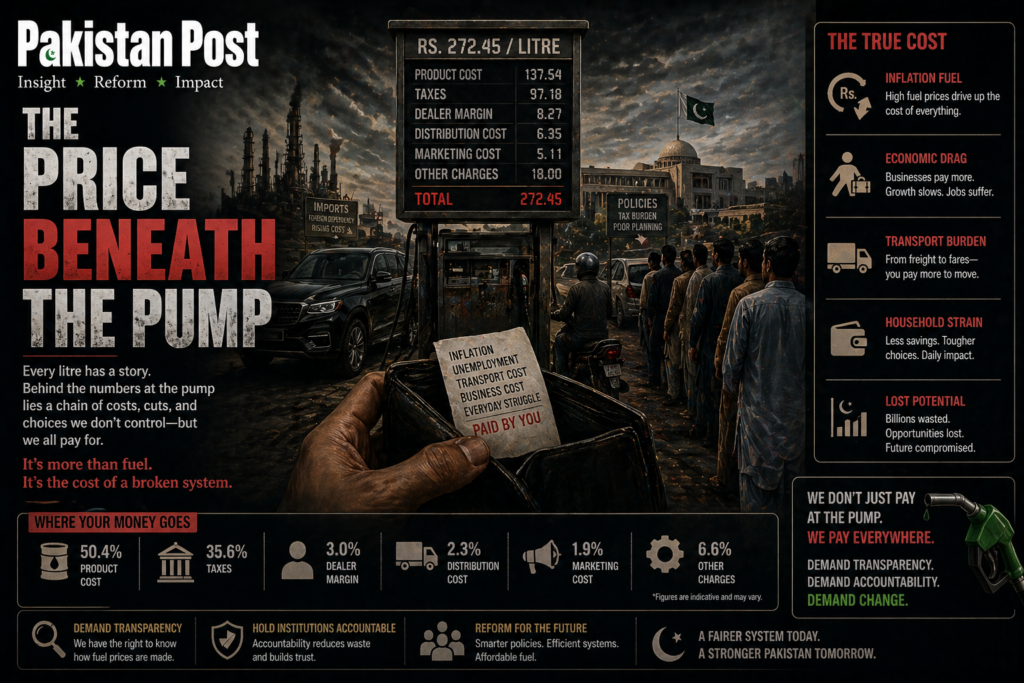
Petrol prices in Pakistan rise with a familiar rhythm, announced in late-night notifications, justified through global benchmarks, and absorbed reluctantly by a public already strained by inflation. The official explanation is always technical, international crude prices have shifted, the exchange rate has moved, fiscal pressures require adjustment. Yet this narrative, while not entirely untrue, conceals a more intricate and less comfortable reality. The pricing of petroleum in Pakistan is not merely an economic calculation, it is a political instrument, a fiscal lever, and, increasingly, a site where structural opacity enables quiet forms of extraction.
At first glance, the pricing mechanism appears methodical. Global oil prices are converted into local currency, refining and transportation costs are added, margins are allocated, and taxes are imposed. The result is presented as a rational outcome of market dynamics and administrative necessity. But the simplicity of this formula is misleading. Each component within it carries layers of discretion, and it is within these layers that the system reveals its true character.
The most visible distortion lies in the gap between international price movements and domestic adjustments. When global prices rise, local prices respond swiftly and often disproportionately. When global prices fall, the downward adjustment is slower, more cautious, and frequently offset by increases in taxes or levies. This asymmetry is not accidental. It reflects a structural dependence on petroleum as a source of government revenue. Fuel is not just energy, it is taxation in liquid form.
The petroleum levy, in particular, has evolved into a critical fiscal tool. It is adjustable, relatively easy to collect, and politically expedient compared to direct taxation. Yet it is also regressive, placing a heavier burden on those who spend a larger share of their income on transport and basic goods. Unlike income tax, it does not differentiate between the affluent and the struggling. Every litre purchased carries within it a silent transfer of wealth from the consumer to the state.
This would be less contentious if the system were transparent and predictable. It is neither. The opacity surrounding pricing decisions creates space for doubt, speculation, and, at times, justified suspicion. One recurring concern is the treatment of existing fuel stocks. When prices are increased, the adjustment is applied uniformly, regardless of when the fuel was imported or refined. This means that inventory acquired at lower costs is often sold at higher prices, generating windfall margins. Whether these gains accrue to the state, to oil marketing companies, or are shared across the supply chain is rarely clarified in a manner that satisfies public scrutiny.
Such practices may not violate formal regulations, but they raise questions about fairness and accountability. In a system already burdened by economic inequality, the perception that pricing mechanisms allow for disproportionate gains at the expense of consumers undermines trust. It reinforces the belief that the system is designed not merely to function, but to extract.
Beyond pricing, the petroleum supply chain itself presents multiple points where inefficiency and discretion intersect. Import contracts, refining processes, transportation logistics, and retail distribution each involve actors with varying degrees of oversight. Where transparency is limited, opportunities for manipulation emerge. Delays in shipments, inconsistencies in supply, and fluctuations in availability are often explained as logistical challenges, yet they can also create conditions for speculative behavior.
Hoarding is one such phenomenon. In anticipation of price increases, segments of the supply chain may restrict availability, releasing stock only after new prices take effect. This practice, while difficult to prove conclusively, is widely reported and contributes to artificial shortages. The result is a market that does not merely respond to price signals but anticipates and exploits them.
The refining sector adds another layer of complexity. Pakistan’s refineries have long operated with outdated configurations, producing a fuel mix that does not align with modern consumption patterns. Efforts to upgrade capacity have been slow, hindered by policy uncertainty and inconsistent incentives. In the absence of modernization, the country remains dependent on imported refined products, exposing it to global volatility and limiting its ability to control costs. This dependency is not just an economic vulnerability, it is a structural constraint that shapes the entire pricing ecosystem.
At the retail level, the system becomes even more opaque. Consumers frequently report discrepancies in fuel measurement, variations in quality, and unauthorized adjustments in pricing. While regulatory mechanisms exist to monitor these practices, enforcement is uneven. Inspections are sporadic, penalties are limited, and compliance often depends on local dynamics rather than uniform standards. For the average consumer, the petrol pump is not just a point of purchase, it is a point of uncertainty.
The cumulative effect of these dynamics is a system where formal structures coexist with informal practices. Rules are defined, but their application is inconsistent. Oversight exists, but its reach is limited. Accountability is promised, but rarely experienced. In such an environment, corruption does not always appear as overt illegality. It manifests as tolerated inefficiency, as discretionary adjustment, as a pattern of decisions that consistently disadvantage the consumer while protecting the system.
The broader economic context reinforces this pattern. Faced with fiscal deficits and limited avenues for revenue generation, the state relies increasingly on indirect taxation. Petroleum becomes an attractive target because it is difficult to evade and easy to justify. Yet this reliance creates a structural incentive to maintain higher prices, even when global conditions would allow for relief. The system, in effect, becomes self-reinforcing. High prices generate revenue, revenue sustains the system, and the system resists changes that would reduce its own income.
Breaking this cycle requires more than incremental adjustments. It demands a rethinking of how petroleum pricing is structured and governed. Transparency must be the starting point. Each component of the price, from import cost to final levy, should be clearly disclosed and independently verifiable. This is not merely a matter of public relations; it is a prerequisite for accountability.
Regulation must also evolve from passive oversight to active enforcement. Monitoring stock levels, preventing hoarding, and ensuring fair retail practices require not just rules but consistent application. Penalties for violations must be credible enough to deter misconduct, rather than treated as a cost of doing business.
At a deeper level, the fiscal dependence on petroleum must be addressed. Expanding the tax base, improving direct tax collection, and reducing inefficiencies in public spending can lessen the pressure to extract revenue through fuel prices. Without such reforms, any attempt to rationalize pricing will encounter resistance from within the system itself.
Investment in refining capacity and supply chain efficiency is equally critical. A more self-sufficient and technologically updated sector can reduce exposure to external shocks and limit opportunities for manipulation. This is not a short-term solution, but it is a necessary one.
Ultimately, the question is not whether petrol prices should rise or fall. It is whether the system that determines them is fair, transparent, and accountable. In its current form, it is none of these things. It operates in a grey space between regulation and discretion, where outcomes are shaped as much by structural incentives as by market forces.
For the consumer, the price displayed at the pump is the end of a long chain of decisions, many of which remain hidden. Understanding that chain is the first step toward reform. Changing it will require confronting not only economic realities but institutional habits that have long gone unquestioned. Until then, the true cost of fuel will remain higher than the number on the meter, measured not just in rupees, but in trust.
A Public Service Message