Artificial Intelligence and Structural Transformation in Pakistan’s Economy

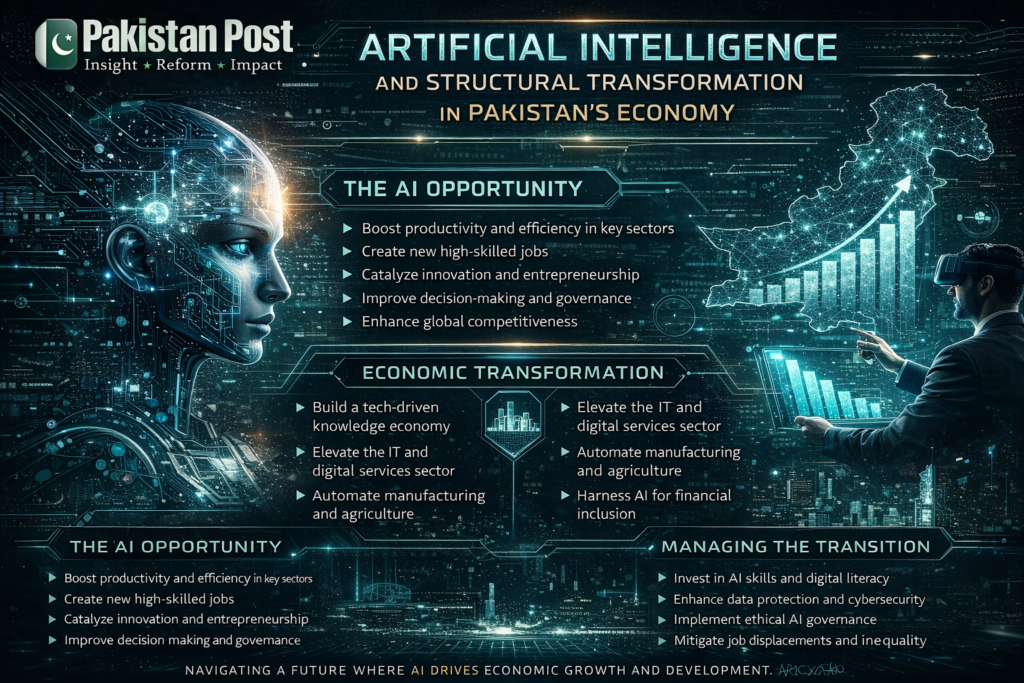
Artificial intelligence is no longer a distant technological frontier but a consolidating force reshaping global economic hierarchies, productivity regimes, and labour markets. It is also becoming a site of strategic competition, where a small cluster of technology superpowers and platform corporations increasingly define the terms of access, innovation, and value creation. Within this emerging global AI order, Pakistan occupies a peripheral yet consequential position, characterized by high exposure to technological diffusion but limited capacity for endogenous innovation. The central question is not whether Pakistan will adopt artificial intelligence, but whether it will do so in a way that expands productive capacity across society or deepens structural asymmetries already embedded in its political economy.
Pakistan’s comparative position in the global AI value chain is shaped by three interlocking constraints. The first is infrastructural. Digital infrastructure remains uneven, with persistent gaps in broadband penetration, data center capacity, and cloud computing access outside major urban hubs. While mobile connectivity has expanded rapidly, the transition from connectivity to computational capability remains incomplete. Artificial intelligence systems depend not only on data availability but on high-performance computing environments, stable energy supply, and secure digital ecosystems. These foundational elements are still developing in Pakistan, creating a structural dependence on external platforms and foreign-hosted cloud services.
The second constraint is human capital formation. Pakistan produces a large number of graduates in general disciplines but faces a persistent shortage of advanced technical expertise in machine learning, data science, computational engineering, and AI system design. This skills gap is not merely educational but institutional. Universities are often disconnected from industry-led innovation ecosystems, resulting in weak translation of academic output into deployable technological solutions. Consequently, Pakistan risks becoming a consumer of AI systems designed elsewhere rather than a producer of context-specific algorithms tailored to local economic and social realities.
The third constraint is regulatory and institutional readiness. Artificial intelligence governance requires anticipatory regulatory frameworks capable of addressing issues such as algorithmic accountability, data sovereignty, intellectual property rights in machine-generated outputs, and ethical standards for automated decision-making. Pakistan’s regulatory landscape remains fragmented, with overlapping jurisdictional authority across institutions and limited capacity for technology foresight. In the absence of coherent AI governance, adoption may proceed in an ad hoc manner, driven more by market incentives and external platform penetration than by strategic national planning.
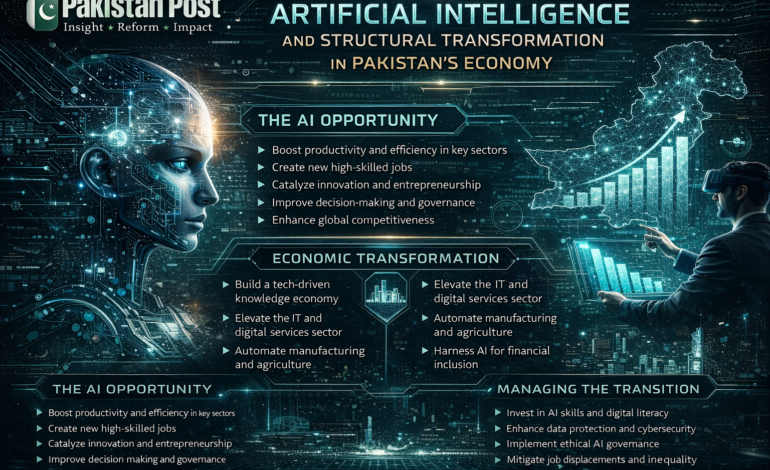
Yet constraints alone do not define trajectory. Pakistan’s economy presents several domains where AI diffusion could generate significant productivity gains if appropriately structured. Agriculture, which remains the largest employer, is one such sector. Precision agriculture powered by machine learning models, satellite imaging, and predictive analytics has the potential to optimize crop yields, reduce input waste, and improve supply chain efficiency. However, without equitable access to digital tools, these gains risk being captured by large landholders, reinforcing existing agrarian inequalities.
Manufacturing is another sector where AI-enabled automation and predictive maintenance could enhance competitiveness, particularly in textiles and light engineering. Global supply chains are increasingly integrating AI-driven logistics and quality control systems. If Pakistani firms fail to integrate these technologies, they may face marginalization in export markets where compliance with digital production standards becomes implicit. At the same time, automation threatens to displace low-skill labor, raising the question of whether productivity gains will translate into wage growth or labor displacement.
The services sector, particularly finance, logistics, and retail, is already experiencing early-stage AI integration through algorithmic credit scoring, demand forecasting, and customer analytics. However, these systems often operate as imported black-box technologies, embedded within global fintech and platform ecosystems. This raises concerns about data extraction and value capture, where local user data is monetized externally while domestic institutions retain limited control over analytical outputs.
At the macroeconomic level, AI introduces a paradox. On one hand, it offers the possibility of productivity acceleration in economies historically constrained by low capital intensity and inefficiency. On the other hand, it risks intensifying inequality between sectors integrated into digital platforms and those excluded from them. This duality reflects what scholars describe as algorithmic capitalism, where value creation is increasingly mediated by data flows, platform monopolies, and network effects rather than traditional industrial production.
In Pakistan’s context, this could manifest as a widening divide between formal and informal economies. The formal sector, particularly multinational-linked firms and digitally integrated enterprises, is likely to adopt AI more rapidly, benefiting from efficiency gains and global connectivity. The informal sector, which employs a significant portion of the workforce, may remain structurally excluded from these gains due to lack of digitization, financial access, and technological literacy. This divergence could deepen existing patterns of economic dualism.
Urban-rural disparities represent another axis of potential inequality. Urban centers such as Karachi, Lahore, and Islamabad are better positioned to integrate AI ecosystems due to concentration of infrastructure, talent, and institutional presence. Rural regions, by contrast, may experience AI primarily as an external force reshaping agricultural markets, credit access, and labor demand without corresponding local capacity-building. The risk is not only economic exclusion but informational asymmetry, where rural actors become subjects of algorithmic systems they neither understand nor influence.
The question of employment is particularly sensitive. Historical technological transitions have often generated short-term displacement followed by long-term job creation. However, AI differs from previous waves of automation in its cognitive reach. It does not only replace manual labor but increasingly substitutes analytical and administrative tasks. In Pakistan, where a large share of educated employment is concentrated in routine cognitive roles, the displacement risk extends beyond low-skill labor into segments of the middle class.
Policy response therefore becomes central. A reactive stance toward AI adoption will likely amplify inequality and dependency. A strategic approach would require investment in three areas simultaneously. First, digital infrastructure expansion, including national cloud capacity and data localization frameworks that ensure sovereign control over critical datasets. Second, large-scale human capital development focused on AI literacy, not only at the university level but across vocational and secondary education systems. Third, regulatory modernization that balances innovation with safeguards for privacy, transparency, and algorithmic accountability.
However, policy design alone is insufficient without institutional coherence. Pakistan’s historical challenge has not been the absence of policy intent but the fragmentation of implementation capacity. AI governance requires coordination across ministries of finance, information technology, education, and industry, as well as alignment with provincial governments and private sector stakeholders. Without such coordination, AI policy risks becoming symbolic rather than transformative.
There is also a geopolitical dimension to consider. Artificial intelligence is increasingly embedded within global power competition, particularly between the United States and China. Access to AI infrastructure, semiconductor supply chains, and cloud ecosystems is shaped by strategic alignments. Pakistan’s position within this landscape will influence not only its technological trajectory but its economic sovereignty. Dependence on external AI platforms may limit policy autonomy in the long term, particularly if data governance becomes a site of geopolitical contestation.
The notion of AI sovereignty is therefore emerging as a critical concept. It refers not only to the ability to develop domestic AI systems but also to govern data flows, regulate algorithmic systems, and ensure that technological integration aligns with national development priorities. For Pakistan, achieving full AI sovereignty may be unrealistic in the short term, but partial sovereignty through strategic partnerships and localized capacity-building remains a viable objective.
Ultimately, the impact of artificial intelligence on Pakistan’s economy will not be determined by technology alone but by the institutional and political frameworks within which it is embedded. AI can function either as an accelerant of inclusive growth or as an amplifier of structural inequality. The divergence between these two outcomes will depend on whether Pakistan approaches AI as a strategic development tool or as an externally driven technological inevitability.
The global experience suggests that late adopters are not necessarily doomed to marginalization, but they must be deliberate in shaping adoption pathways. Countries that have successfully integrated digital technologies have done so by aligning technological diffusion with industrial policy, education reform, and institutional modernization. For Pakistan, the challenge is not to replicate existing models but to adapt them to local constraints and opportunities.
Artificial intelligence, in its essence, is a force multiplier. It magnifies existing capacities but does not automatically redistribute them. In an economy marked by deep structural inequalities, the direction of this magnification matters profoundly. Whether AI becomes a bridge toward productivity convergence or a mechanism of further divergence will depend on choices made at this formative stage of technological integration.
A Public Service Message