The Diesel Trap and the Silent Crisis in Pakistan’s Fields

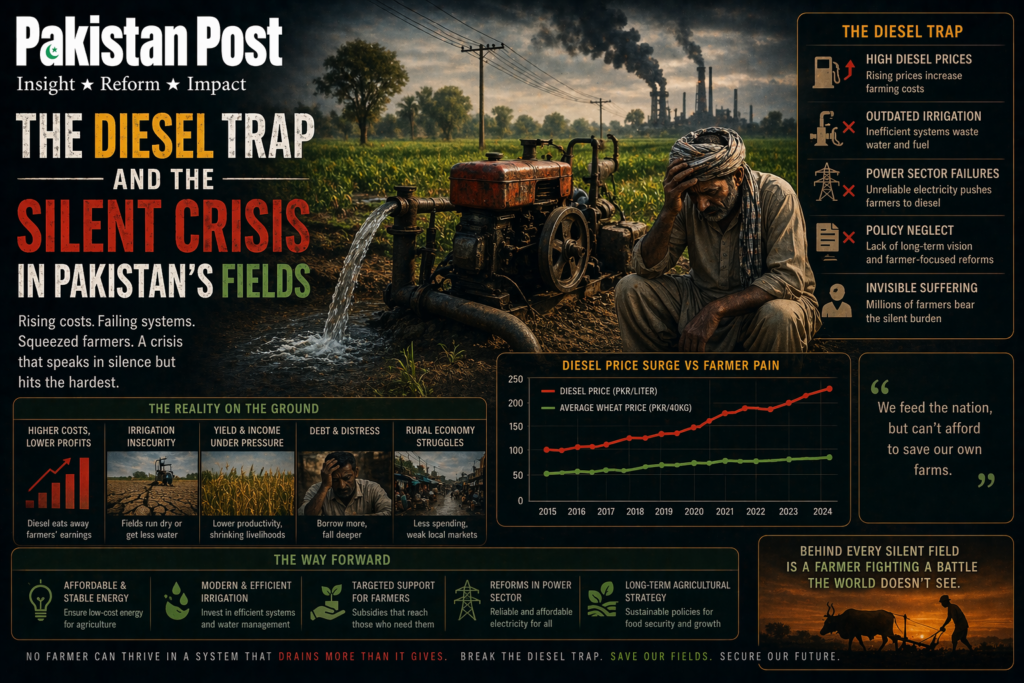
In Pakistan’s countryside, the sound of agriculture is increasingly the sound of diesel engines. It powers tubewells, runs tractors, moves harvests, and sustains irrigation in a water-stressed economy. Yet this dependence has become a trap. As diesel prices climb, the cost of simply producing food is rising faster than the price farmers receive for it. What appears on paper as a routine adjustment in fuel pricing is, in practice, reshaping the economics of farming and quietly eroding the foundation of rural livelihoods.
The most immediate impact is visible in staple crops. Wheat, already under pressure from stagnant procurement incentives and input inflation, is increasingly becoming a low-margin or even loss-making crop for small and medium farmers. After potato cycles that failed to deliver proportional returns, wheat now faces a similar squeeze. The problem is not harvest alone, but the cost of reaching harvest. Every stage of cultivation, ploughing, irrigation, transport, and threshing, is now indexed to diesel.
This is where Pakistan’s agricultural economy reveals a structural contradiction. Crop prices remain largely stagnant due to procurement rigidity, market intermediaries, and limited state intervention in price stabilization. Meanwhile, input costs are highly volatile, driven by global oil prices, exchange rate pressures, and domestic taxation structures. The result is a widening gap between cost of production and farm-gate returns, pushing farmers into chronic income compression.
At the center of this imbalance lies diesel itself, the lifeblood of rural production. Unlike electricity, which has seen partial subsidization and targeted reforms, diesel is fully exposed to fiscal adjustments. Each increase in petroleum levies and international pass-through pricing directly translates into higher agricultural costs. For farmers who rely on diesel-powered tubewells for irrigation in the absence of reliable canal systems, this is not a marginal cost increase, it is a structural shock.
The transmission mechanism is brutally efficient. When diesel becomes more expensive, irrigation costs rise immediately. When irrigation costs rise, input intensity falls. When input intensity falls, yields become unstable. And when yields become unstable, farmer income becomes unpredictable. This chain reaction does not require policy intent to operate, it functions automatically within the structure of the rural economy.
Yet the crisis is not only about fuel prices. It is about the absence of a coherent policy buffer between global energy markets and domestic agricultural production. In most agricultural economies, fluctuations in energy prices are partially absorbed through subsidies, targeted support, or procurement adjustments. In Pakistan, however, policy response is fragmented. Energy pricing is treated as a fiscal instrument, while agriculture is treated as a separate policy domain. The link between the two is rarely addressed in a unified framework.
This institutional separation has consequences. Agricultural authorities focus on output targets, while energy authorities focus on revenue collection and fiscal stabilization. In between lies the farmer, exposed simultaneously to volatile input costs and rigid output prices. The result is not just inefficiency, but systematic vulnerability.
The procurement system for wheat illustrates this imbalance. Official support prices are announced periodically, but they often lag behind real increases in production costs. When diesel prices rise sharply within a season, procurement adjustments rarely respond in time. Farmers are therefore forced to absorb cost shocks without corresponding compensation. In effect, price stability is enforced at the output end, while volatility is concentrated at the input end.
This asymmetry is reinforced by market structure. Middlemen and intermediaries dominate the distribution chain, absorbing a significant portion of value between farm and market. Farmers, particularly smallholders, lack bargaining power and storage capacity, forcing them into immediate post-harvest sales regardless of price conditions. This weakens their ability to respond to cost pressures and further compresses margins.
The consequences are beginning to accumulate. Rising input costs are discouraging investment in agricultural productivity. Farmers are reducing fertilizer use, delaying mechanization, and in some cases shifting away from high-cost crops altogether. Over time, this leads to lower yields, reduced national output, and increased vulnerability in food security.
The macroeconomic implications are significant. Agriculture remains a foundational sector of Pakistan’s economy, employing a large share of the workforce and contributing to food supply stability. When production costs rise faster than output prices, rural incomes decline, consumption weakens, and inflationary pressures intensify. The crisis is therefore not confined to the countryside, it feeds directly into national economic instability.
At the policy level, the response has been limited and reactive. Fuel pricing continues to be driven primarily by fiscal considerations, particularly the need to manage deficits and external obligations. Agricultural support mechanisms, meanwhile, remain underfunded and structurally weak. There is no effective mechanism to insulate agriculture from energy price volatility, despite the obvious interdependence between the two sectors.
This disconnect reflects a broader governance challenge. Policy is fragmented across ministries, with limited coordination between energy, finance, and agriculture. Each operates within its own mandate, optimizing for its own objectives, while systemic interactions are left unmanaged. The result is policy incoherence at the level where it matters most, in the lived experience of production.
The absence of a diesel mitigation framework for agriculture is particularly striking. In economies where mechanized farming is heavily dependent on fuel, governments often introduce targeted relief measures during price shocks, whether through subsidies, tax adjustments, or direct transfers. In Pakistan, such mechanisms are limited, temporary, and often politically contested, leaving farmers exposed to full market volatility.
There is also a deeper structural issue. The state’s fiscal reliance on petroleum revenues creates an inherent tension. Fuel is not only an input into the economy, it is also a source of government income. This dual role makes it difficult to fully insulate sectors like agriculture from price increases, as doing so would reduce a key revenue stream. The result is a policy environment where short-term fiscal stability is prioritized over long-term productive stability.
Meanwhile, climate variability is intensifying the crisis. Irregular rainfall patterns and groundwater depletion are increasing dependence on diesel-powered irrigation systems. As environmental stress rises, so does fuel consumption, deepening the vulnerability of farmers to price shocks. This creates a feedback loop where climate pressure and energy costs reinforce each other.
The outcome is a rural economy under cumulative strain. Farmers are not only facing higher costs, but also declining predictability. In agriculture, unpredictability is often more damaging than absolute cost increases, because it undermines planning, credit access, and investment decisions. When income becomes uncertain, risk aversion increases, and long-term productivity declines.
Breaking this cycle requires more than incremental subsidy adjustments. It demands a structural rethinking of how energy policy and agricultural policy interact. Diesel pricing cannot be treated in isolation from its impact on food production. Similarly, agricultural planning cannot ignore energy volatility as a core variable in production economics.
A coordinated policy framework would need to recognize diesel as a strategic agricultural input, not just a fiscal instrument. This would involve targeted stabilization mechanisms for farmers, improved efficiency in irrigation infrastructure, and gradual transition toward less fuel-dependent agricultural systems where feasible. It would also require stronger alignment between procurement pricing and real-time production costs.
Equally important is strengthening the agricultural value chain. Reducing intermediary dominance, improving storage capacity, and enabling better market access for farmers could help offset some of the pressure created by rising input costs. Without such reforms, cost increases will continue to be absorbed disproportionately by producers.
Ultimately, the diesel crisis in Pakistan’s agriculture is not simply about fuel. It is about the structure of policy itself, how disconnected systems produce coherent harm at the level of the farmer. It is about a governance model where energy, agriculture, and fiscal policy operate on separate tracks while their consequences converge in the same field.
If current trends persist, the outcome will not be sudden collapse but gradual erosion, of margins, of productivity, and of rural stability. And in a country where agriculture remains central to both livelihoods and food security, that erosion will not remain confined to the countryside.
A Public Service Message