
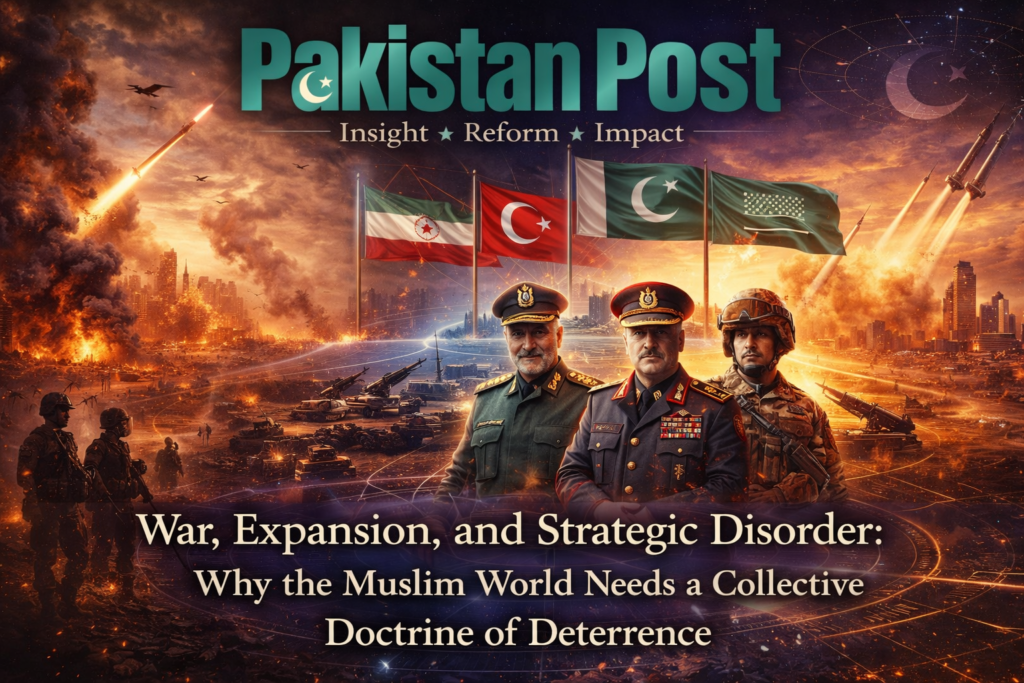
War, Expansion, and Strategic Disorder: Why the Muslim World Needs a Collective Doctrine of Deterrence

The recent conflict involving the United States, Israel, and Iran has reopened a long-standing question that has lingered unresolved since the end of the Cold War: why does instability in the Muslim world so often escalate into prolonged crises with external involvement, and why do regional actors struggle to shape outcomes on their own terms? The war itself, while rooted in immediate triggers and specific strategic calculations, reflects a broader pattern of coercion, strategic expansion, and systemic disorder. It is a pattern in which fragmented responses among Muslim-majority states have repeatedly created conditions that invite intervention, widen conflict, and limit the possibility of sustainable stability.
To frame the issue solely in terms of external action is to miss a critical dimension of the problem. The disorder that characterizes much of the region is not imposed exclusively from outside; it is also a product of internal fragmentation. The absence of coordinated deterrence, the divergence of strategic priorities, and the persistence of intra-regional rivalries have created an environment in which even limited crises can expand rapidly. External powers, acting in pursuit of their own interests, operate within this environment, often exploiting its divisions but also responding to its volatility. The result is a cycle in which fragmentation begets intervention, and intervention reinforces fragmentation.
The collapse of the bipolar order in the early 1990s removed a key structural constraint on this dynamic. During the Cold War, the presence of two competing superpowers imposed a form of external discipline on regional conflicts. While proxy wars were common, the risk of escalation into direct confrontation between major powers created incentives for restraint. The end of this system did not eliminate conflict; it altered its context. In a unipolar world, the capacity for external intervention increased, while the mechanisms for balancing that intervention weakened. For many states in the Muslim world, this shift translated into a strategic vacuum—one that was filled not by collective coordination, but by divergent national strategies.
These strategies were shaped by differing threat perceptions, political systems, and external relationships. Some states aligned closely with Western security frameworks, relying on external guarantees to ensure stability. Others pursued greater autonomy, investing in indigenous capabilities or forming limited regional partnerships. Still others adopted a hedging approach, seeking to balance relationships across multiple powers. While each of these strategies had its own logic, their coexistence without coordination produced a fragmented deterrence landscape. In such a landscape, signals are inconsistent, thresholds are unclear, and the risk of miscalculation is heightened.
The recent war has exposed the consequences of this fragmentation. The conflict unfolded across multiple domains—air, sea, cyber, and economic—yet responses from key regional actors were largely uncoordinated. Diplomatic initiatives emerged in parallel rather than in concert, military postures were adjusted independently, and economic measures reflected national rather than collective priorities. This lack of coherence did not merely reduce effectiveness; it contributed to the escalation of the conflict by failing to present a unified deterrent signal. In the absence of such a signal, the cost of intervention appears lower, and the incentives for expansion increase.
It is in this context that the notion of a collective doctrine of deterrence becomes both relevant and necessary. Such a doctrine does not imply the creation of a formal alliance or the elimination of differences among states. Rather, it represents a framework for coordination that enhances the credibility of deterrence while preserving flexibility. The objective is not to prevent all forms of conflict, but to establish conditions under which escalation is less likely and external intervention is more costly.
The foundation of such a doctrine lies in defense-industrial cooperation. The ability to produce, maintain, and upgrade military capabilities is a critical component of deterrence. Yet across much of the Muslim world, defense industries remain underdeveloped, fragmented, or dependent on external suppliers. This dependence creates vulnerabilities, both in terms of supply chains and strategic autonomy. By investing in joint development, technology sharing, and coordinated procurement, states can enhance their capabilities while reducing reliance on external sources. This does not require uniformity; different states can specialize in different areas, creating a network of complementary strengths.
Intelligence-sharing is another essential pillar. Modern warfare is increasingly driven by information—about threats, intentions, and capabilities. The ability to collect, analyze, and disseminate intelligence in a timely manner can significantly enhance both defensive and deterrent capabilities. Yet intelligence cooperation among Muslim-majority states has historically been limited, constrained by mistrust and divergent priorities. Establishing mechanisms for secure and reliable information exchange, particularly in areas such as missile threats, maritime activity, and cyber operations, can improve situational awareness and reduce the risk of surprise.
Diplomatic coordination provides the political dimension of deterrence. In the absence of a unified voice, external actors can engage with individual states on separate terms, shaping outcomes in ways that may not reflect collective interests. Coordinated diplomatic positions, even if limited to specific issues, can enhance leverage and signal resolve. This does not require consensus on all matters, but it does require agreement on key principles, such as the protection of sovereignty, the prevention of escalation, and the maintenance of stability in critical domains.
The protection of sea lanes is particularly important in this regard. The economic lifelines of the region—energy exports, trade routes, and supply chains—are heavily dependent on maritime security. The recent conflict has highlighted the vulnerability of key chokepoints, such as the Strait of Hormuz, where disruptions can have immediate and far-reaching consequences. Coordinated efforts to monitor, patrol, and secure these routes can reduce the risk of disruption and enhance confidence among both regional and external stakeholders. Such efforts can be supported by joint exercises, information-sharing, and the development of interoperable systems.
Perhaps the most challenging but also the most critical element of a collective doctrine of deterrence is the establishment of shared red lines. These are not rigid or inflexible rules, but agreed thresholds beyond which certain actions are considered unacceptable. The absence of such red lines contributes to uncertainty, as actors are unsure of how others will respond to specific actions. By articulating and communicating these thresholds—particularly with regard to attacks on civilian infrastructure, energy facilities, and critical networks—states can enhance predictability and reduce the likelihood of escalation.
The development of such a doctrine is not without obstacles. Historical rivalries, political differences, and external alignments continue to shape the strategic landscape. Trust, once eroded, is not easily restored, and cooperation requires sustained effort and institutional support. Moreover, the diversity of capabilities and interests among states means that a one-size-fits-all approach is neither feasible nor desirable. The challenge is to create a framework that accommodates diversity while enabling coordination.
The roles of key actors within this framework are particularly significant. Pakistan, with its military capabilities, geographic position, and diplomatic reach, can serve as a bridge between regions and systems. Saudi Arabia and the Gulf states, with their financial resources and influence over energy markets, can support the economic dimension of deterrence. Turkey, with its military experience and strategic location, can contribute to both operational and diplomatic aspects. Iran, despite its contested position, remains an essential participant, as exclusion would undermine the credibility and effectiveness of any collective framework.
External powers will continue to play a role in the region, but the objective of a collective doctrine is to reduce dependence on their intervention. By enhancing internal coordination and capability, regional actors can increase the cost of external involvement and create incentives for engagement on more balanced terms. This does not imply isolation, but a recalibration of relationships that prioritizes autonomy and resilience.
The broader implications of such a shift extend beyond security. A more coordinated and stable environment can support economic development, attract investment, and enhance the well-being of populations. Conversely, continued fragmentation and instability impose costs that are both immediate and long-term, affecting growth, governance, and social cohesion.
In evaluating the prospects for such a doctrine, it is important to avoid both pessimism and over-optimism. The challenges are real, but so are the incentives for change. The recent war has provided a stark reminder of the costs of disorder, creating a window of opportunity for reassessment. Whether this opportunity is seized will depend on the willingness of key actors to move beyond reactive policies and to invest in the structures and relationships necessary for sustained cooperation.
The transition from fragmentation to coordination is unlikely to be rapid or linear. It will involve incremental steps, setbacks, and adjustments. Yet even partial progress can have significant effects, enhancing stability and reducing the likelihood of escalation. Over time, these steps can coalesce into a more coherent and effective framework.
In the final analysis, the need for a collective doctrine of deterrence is not an abstract concept but a practical necessity. The recent conflict has demonstrated that the absence of such a doctrine carries significant risks, not only for individual states but for the region as a whole. By addressing the underlying causes of fragmentation and by building mechanisms for coordination, the Muslim world can begin to shape its own strategic environment rather than being shaped by it.
The question is not whether such a transformation is possible, but whether it is pursued with the clarity, commitment, and pragmatism required. The lessons of the recent war are clear; the challenge lies in translating them into action.
A Public Service Message