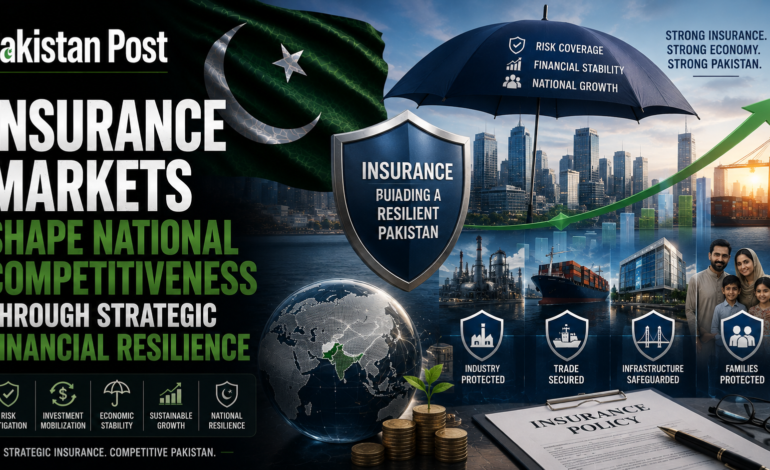
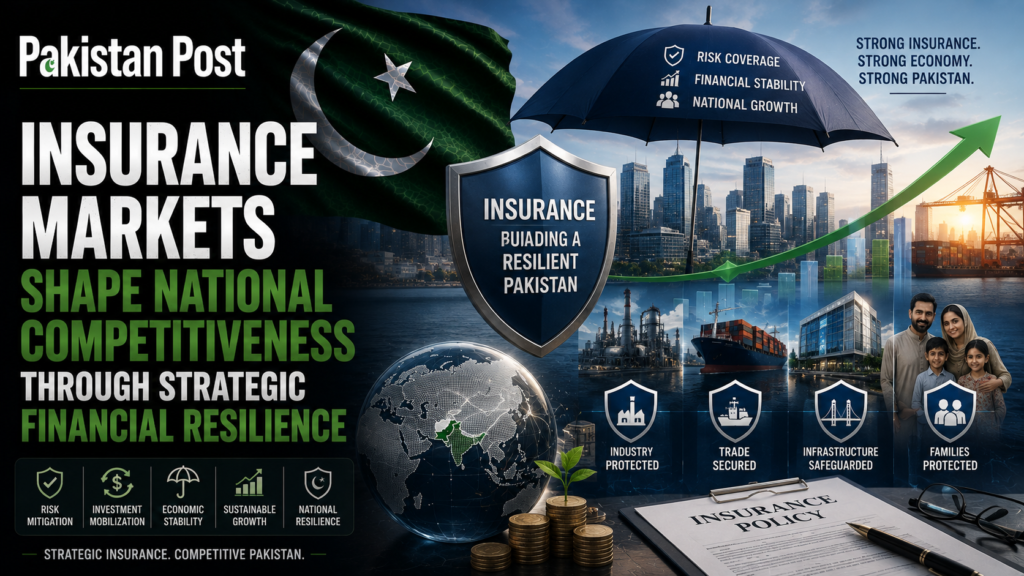
Insurance Markets Shape National Competitiveness Through Strategic Financial Resilience

Pakistan possesses significant opportunities to modernise agricultural insurance through digital technologies already expanding across financial services. Remote sensing, artificial intelligence, satellite imagery and mobile financial platforms could substantially improve underwriting accuracy while lowering administrative costs. Such integration would strengthen rural resilience and reduce repeated fiscal burdens arising from disaster compensation.
Insurance rarely dominates national economic debates, yet history demonstrates that prosperous economies are built not only upon factories, ports, highways and digital networks, but equally upon sophisticated systems capable of absorbing uncertainty before it becomes crisis. Financial markets allocate capital, governments formulate regulation, industries pursue investment and entrepreneurs innovate, but none of these activities operate efficiently where risk remains unmanaged. Insurance therefore functions as one of the least visible yet most consequential pillars of national competitiveness. It transforms uncertainty into measurable liability, enables productive investment, strengthens confidence among domestic and foreign investors, protects infrastructure financing, underwrites international trade and cushions societies against increasingly complex economic disruptions.
As geopolitical volatility, climate instability, cyber threats and technological transformation redefine global commerce, advanced insurance ecosystems have become instruments of national economic strategy rather than merely commercial financial services. Countries seeking sustained industrialisation increasingly regard insurance regulation as part of broader economic governance, integrated with fiscal policy, infrastructure development, agricultural productivity, maritime logistics, export competitiveness and financial market stability. Insurance has consequently evolved beyond compensation for losses into an institutional mechanism supporting long term economic resilience.
Pakistan possesses an insurance industry with considerable unrealised potential, yet it remains substantially smaller than comparable emerging economies. Insurance penetration remains limited, awareness is uneven, product diversification is inadequate and institutional confidence continues to face persistent challenges. The result extends beyond financial services. Weak insurance capacity constrains industrial investment, discourages innovation, elevates borrowing costs, limits infrastructure financing and increases macroeconomic vulnerability whenever natural disasters or economic shocks emerge.
International investors evaluate political stability, regulatory predictability, contract enforcement, taxation and market opportunities before allocating capital. Increasingly they also assess the sophistication of domestic insurance markets because insurance directly influences operational continuity, project financing and investment security. Large manufacturing facilities, renewable energy projects, logistics corridors, ports, airports, telecommunications infrastructure and digital industries all require comprehensive risk coverage before international lenders approve financing. Where insurance markets remain underdeveloped, financing becomes more expensive while investment decisions increasingly migrate towards jurisdictions capable of providing stronger financial protection.
Modern economies therefore compete not only through labour costs or industrial incentives but equally through institutional mechanisms capable of reducing uncertainty. Insurance markets perform precisely this function by distributing risk across wider financial systems, encouraging entrepreneurship and protecting productive assets from catastrophic loss.
The relationship between insurance and industrialisation has become particularly visible across East Asia. Countries such as Japan, Singapore and South Korea gradually transformed insurance regulation into an integrated component of industrial policy. Manufacturing expansion proceeded alongside sophisticated commercial insurance products covering export risks, engineering projects, cyber security, supply chain disruption, professional liability and environmental responsibility. Insurance companies themselves became major institutional investors, financing government securities, corporate bonds and infrastructure projects while simultaneously strengthening domestic capital markets.
China similarly incorporated insurance reforms into broader financial liberalisation. The expansion of commercial insurance accompanied industrial modernisation, technological development and Belt and Road infrastructure financing. Insurance institutions increasingly supported renewable energy projects, advanced manufacturing and logistics infrastructure while regulatory authorities strengthened solvency standards and consumer protection to improve market confidence.
European economies demonstrate another dimension of insurance competitiveness. Infrastructure investment across transport, energy and digital connectivity frequently depends upon extensive insurance arrangements involving public private partnerships, pension funds and global reinsurance markets. Sophisticated regulatory oversight enables insurers to assume complex risks while maintaining financial stability. Consequently insurance functions as a catalyst rather than merely a consequence of economic development.
Pakistan’s insurance landscape remains considerably narrower despite substantial economic requirements. Insurance penetration remains low relative to regional and international benchmarks. Significant segments of agriculture, small enterprises, logistics, technology startups and informal businesses continue operating with minimal protection against operational risks. This limits productivity because entrepreneurs frequently avoid expansion where potential losses could threaten business survival.
Commercial banks also encounter increased lending risks where collateral remains insufficiently insured. Consequently financing becomes more conservative, particularly for innovative sectors lacking established credit histories. Insurance therefore indirectly influences access to finance by reducing uncertainty surrounding productive investment.
Agriculture illustrates perhaps the most significant structural challenge. Pakistan’s agricultural economy remains highly vulnerable to floods, droughts, pest infestations and increasingly unpredictable climatic conditions. Individual farmers frequently absorb catastrophic losses without institutional mechanisms capable of facilitating rapid recovery. Government relief packages consequently become the default response following disasters, placing recurrent pressure upon public finances while encouraging expectations of ad hoc fiscal intervention rather than systematic risk management.
International agricultural economies increasingly utilise crop insurance integrated with satellite monitoring, climate modelling, digital land records and weather analytics. Parametric insurance products automatically compensate producers when predefined environmental conditions occur, reducing administrative delays while improving financial certainty. Such mechanisms encourage investment in higher productivity technologies because farmers gain greater confidence that catastrophic events will not eliminate years of accumulated capital.
Maritime commerce presents another strategic dimension. Pakistan’s economic future increasingly depends upon expanding international trade, port development and logistics integration. Every maritime shipment involves multiple insurance arrangements covering cargo, vessels, ports, liability, environmental damage and trade finance. Competitive ports require sophisticated marine insurance ecosystems capable of supporting international shipping standards.
Karachi Port, Port Qasim and the emerging strategic significance of Gwadar collectively highlight the growing importance of maritime insurance. International shipping companies evaluate legal certainty, claims settlement mechanisms and insurance availability before expanding commercial operations. Weak insurance capacity increases transaction costs while reducing logistical competitiveness relative to regional maritime hubs.
Global shipping increasingly confronts cyber attacks, piracy, geopolitical disruptions and climate related operational risks. Marine insurance has consequently evolved into a highly specialised financial discipline integrating cybersecurity assessments, geopolitical intelligence and advanced risk modelling. Pakistan’s maritime ambitions therefore require corresponding modernisation of insurance regulation alongside broader port development strategies.
Infrastructure financing equally depends upon sophisticated insurance architecture. Large transportation networks, energy facilities, telecommunications systems and urban development projects involve complex engineering risks extending across decades. International lenders routinely require comprehensive insurance before releasing project finance. Delays in claims settlement, regulatory uncertainty or insufficient underwriting capacity increase financing costs while discouraging investment.
Pakistan’s ambitious infrastructure requirements therefore cannot rely exclusively upon engineering expertise or fiscal allocation. Financial resilience constitutes an equally essential component of infrastructure governance. Insurance markets capable of absorbing construction risks, operational disruptions and environmental liabilities significantly improve project bankability while attracting institutional investors.
The energy sector further demonstrates insurance’s strategic significance. Conventional power generation, renewable energy facilities, transmission infrastructure and emerging hydrogen technologies all involve technical risks requiring specialised insurance expertise. Countries pursuing energy transition increasingly depend upon insurers capable of evaluating evolving technological risks while supporting private investment.
Pakistan’s renewable energy ambitions similarly require expanded insurance capacity covering solar facilities, wind installations, battery storage, transmission systems and climate related operational challenges. Without adequate insurance, financing renewable infrastructure becomes more expensive while project development slows.
Technological innovation represents another frontier where insurance increasingly determines competitiveness. Artificial intelligence, biotechnology, fintech, advanced manufacturing and digital commerce introduce novel categories of commercial risk. Cyber insurance has become among the fastest expanding segments globally as ransomware attacks, data breaches and digital infrastructure disruptions increasingly threaten economic stability.
Pakistan’s expanding digital economy cannot achieve sustained growth without corresponding development of cyber insurance markets. Financial institutions, telecommunications companies, digital payment platforms and technology startups require specialised products protecting operational continuity while encouraging innovation. Regulatory authorities likewise require frameworks establishing cybersecurity standards alongside insurance market development.
Insurance companies themselves are simultaneously undergoing profound technological transformation. Artificial intelligence increasingly supports fraud detection, actuarial modelling, claims management and customer services. Blockchain technologies improve contract verification while reducing administrative costs. Digital platforms enable micro insurance products reaching previously underserved populations through mobile devices.
Pakistan possesses favourable demographic conditions for digital insurance expansion. High mobile penetration, growing fintech adoption and increasing digital payments create opportunities for innovative insurance delivery models. Regulatory flexibility supporting digital experimentation could substantially expand financial inclusion while strengthening market efficiency.
However, technological innovation alone cannot compensate for institutional weaknesses. Effective insurance markets require regulatory credibility, judicial efficiency, contract enforcement and transparent supervision. Confidence remains the fundamental currency of insurance. Consumers purchase promises regarding future compensation rather than tangible products. Consequently institutional trust directly influences market expansion.
Pakistan has implemented important regulatory improvements over recent decades, yet further strengthening remains essential. Risk based supervision, enhanced solvency requirements, consumer protection mechanisms and transparent governance standards would improve investor confidence while supporting international integration. Regulatory predictability remains particularly important because insurance liabilities frequently extend across many years.
International regulatory experience provides valuable lessons. The European Union’s Solvency II framework emphasises capital adequacy based upon underlying risks rather than arbitrary financial thresholds. This encourages sophisticated risk management while improving resilience during financial crises. Singapore integrates insurance supervision with broader financial stability objectives, facilitating innovation without compromising prudential oversight. Australia has strengthened catastrophe insurance alongside climate resilience policies, recognising growing environmental risks affecting long term economic sustainability.
These experiences illustrate that successful insurance regulation balances innovation with stability. Excessive regulation suppresses market development while insufficient oversight undermines public confidence. Pakistan’s challenge therefore involves constructing proportionate regulatory architecture encouraging competition, technological innovation and financial resilience simultaneously.
Another structural limitation concerns public awareness. Insurance frequently remains misunderstood as discretionary expenditure rather than essential financial planning. Cultural preferences, limited financial literacy and historical distrust have constrained demand. Expanding insurance therefore requires comprehensive public education integrated with broader financial inclusion strategies.
Educational institutions, banking networks, professional associations and digital media could collectively improve awareness regarding insurance’s economic role. Financial literacy programmes should emphasise risk management rather than merely product marketing. Citizens increasingly confronting climate uncertainty, healthcare costs and economic volatility require greater understanding of insurance’s protective function.
Small and medium enterprises deserve particular policy attention because they generate substantial employment while remaining highly vulnerable to operational disruptions. Many operate without adequate property, liability or business interruption coverage. Economic shocks consequently produce disproportionate business failures affecting employment and supply chains.
Tailored insurance products designed specifically for SMEs could substantially strengthen economic resilience. Government supported guarantee mechanisms, digital distribution platforms and simplified regulatory procedures would encourage broader participation while supporting entrepreneurship.
The reinsurance sector also deserves strategic consideration. Domestic insurers cannot independently absorb catastrophic national losses arising from earthquakes, floods or major industrial accidents. International reinsurance markets distribute such risks globally, strengthening national financial resilience. Expanding relationships with international reinsurers therefore represents both commercial necessity and strategic financial policy.
Climate change further reinforces insurance’s strategic importance. Pakistan has repeatedly experienced devastating floods, heatwaves and environmental disruptions imposing enormous fiscal costs. Insurance cannot prevent disasters, yet it significantly accelerates recovery by mobilising private financial resources alongside government assistance.
Climate risk modelling should therefore become integrated within national planning. Insurance regulators, meteorological agencies, disaster management authorities and financial institutions require coordinated data sharing supporting more accurate pricing and improved resilience planning. Public private partnerships could expand catastrophe insurance while reducing long term fiscal exposure.
Strategically, insurance contributes directly to national resilience by protecting critical infrastructure supporting defence logistics, communications, transportation and energy security. Modern national security increasingly encompasses economic continuity alongside traditional military preparedness. Financial resilience consequently becomes an essential component of comprehensive national resilience planning.
International investors increasingly evaluate Environmental, Social and Governance standards alongside financial performance. Insurance companies play an expanding role in promoting responsible corporate governance by incorporating environmental risk assessments, workplace safety standards and operational resilience into underwriting decisions. Pakistan’s corporate sector could benefit substantially from aligning insurance practices with evolving international investment expectations.
Looking forward, Pakistan requires a comprehensive national insurance strategy extending beyond incremental regulatory adjustments. Insurance policy should become integrated with industrial planning, export promotion, infrastructure finance, climate adaptation, agricultural modernisation and digital transformation. Fragmented sectoral reforms cannot fully exploit insurance’s broader developmental potential.
The strategic objective should not merely involve increasing premium volumes but constructing an institutional ecosystem reducing uncertainty across the national economy. Stronger insurance markets encourage entrepreneurship because individuals become more willing to assume productive risks. Financial institutions lend more confidently. International investors perceive lower operational uncertainty. Infrastructure projects secure financing more efficiently. Agricultural productivity becomes more resilient. Maritime commerce expands under stronger commercial protections. Technology companies innovate with greater confidence. Collectively these dynamics reinforce national competitiveness.
Several policy initiatives deserve priority. Regulatory modernisation should adopt internationally recognised risk based supervision while strengthening solvency standards and governance requirements. Digital insurance frameworks should encourage innovation through regulatory sandboxes supporting artificial intelligence, blockchain verification and mobile insurance platforms. Agricultural insurance should integrate satellite technologies with parametric products reducing administrative complexity. Marine insurance capability should expand alongside port modernisation strategies supporting international shipping competitiveness. Cyber insurance frameworks should accompany national digital transformation initiatives protecting critical economic infrastructure.
Government should encourage insurance sector investment in long term infrastructure through prudential reforms facilitating institutional investment while preserving financial stability. Capital market development should proceed alongside insurance expansion, enabling insurers to diversify portfolios while financing productive economic assets. Public procurement standards should incorporate comprehensive insurance requirements improving infrastructure resilience.
Financial literacy programmes require national coordination involving educational institutions, commercial banks, insurers and professional associations. Public awareness should reposition insurance as productive economic infrastructure rather than discretionary household expenditure.
Pakistan’s establishment institutions equally possess important responsibilities regarding economic resilience. National security planning increasingly intersects with financial stability, climate resilience, digital security and infrastructure protection. Insurance markets contribute directly to these objectives by reducing systemic vulnerabilities before crises emerge. Integrating insurance considerations within broader strategic planning would strengthen institutional preparedness across multiple sectors.
Ultimately, competitive economies are distinguished not only by their capacity to generate wealth but by their ability to preserve productive capacity when confronted by uncertainty. Insurance performs precisely this stabilising function. It transforms unpredictable shocks into manageable financial obligations, enabling societies to pursue ambitious development without becoming paralysed by risk. For Pakistan, modernising insurance architecture represents considerably more than financial sector reform. It constitutes an investment in national resilience, institutional credibility, investor confidence and sustainable economic transformation. Nations capable of mastering uncertainty consistently outperform those merely reacting to crisis, and within that enduring lesson, insurance remains one of the most strategic yet least appreciated foundations of modern statecraft and economic competitiveness.
A Public Service Message