Digital Customs Intelligence Strengthens Pakistan’s Border Trade Competitiveness

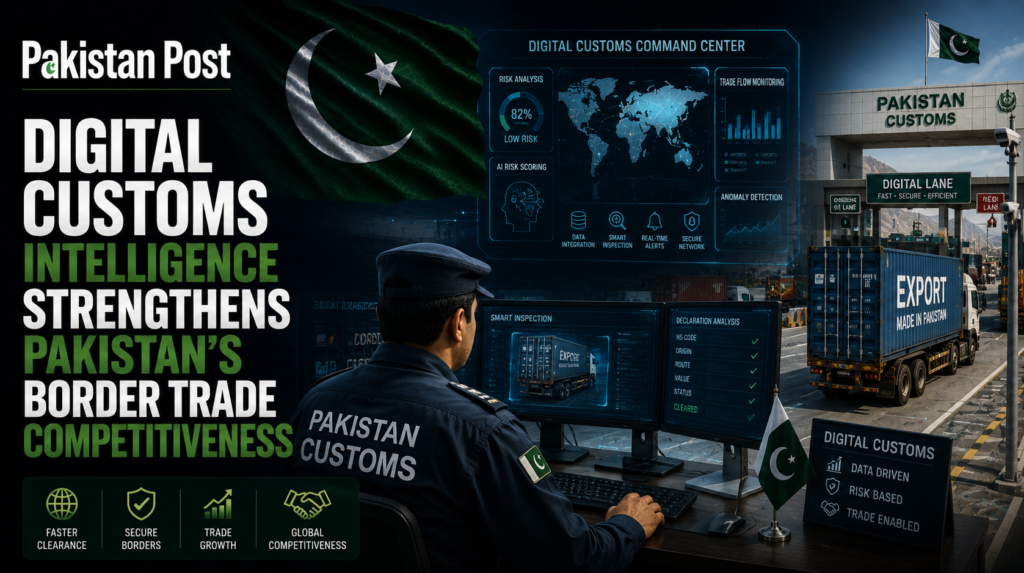
International trade is undergoing a profound administrative transformation. The competitiveness of modern economies increasingly depends not only upon ports, highways and industrial production but also upon the intelligence embedded within border governance. Customs administrations are evolving from paperwork driven institutions into sophisticated data organisations capable of identifying commercial risk before cargo reaches national territory. Artificial intelligence, predictive analytics, blockchain enabled documentation, machine learning assisted inspections and automated clearance systems are redefining how governments balance trade facilitation with national security. The distinction between customs administration and strategic governance is gradually disappearing as border agencies become central actors in economic resilience, revenue mobilisation, financial integrity and supply chain security.
For Pakistan, this transformation presents a strategic opportunity rather than merely a technological challenge. The country’s geographic position connects South Asia, Central Asia, Western China and the Middle East, yet logistics performance continues to underperform relative to its geographic potential. Delays in customs clearance, fragmented institutional coordination, inconsistent enforcement standards, documentation duplication and limited digital integration continue to impose substantial costs upon exporters, importers and government alike. While physical infrastructure has attracted considerable investment during recent years, administrative infrastructure has not advanced at an equivalent pace.
Across advanced trading economies, customs agencies increasingly operate through predictive rather than reactive governance. Artificial intelligence analyses millions of historical transactions, shipping manifests, financial declarations, importer behaviour and international intelligence databases to identify suspicious consignments before physical inspection becomes necessary. Instead of examining every container, customs authorities concentrate resources upon cargo displaying statistically significant anomalies. Legitimate trade moves more rapidly while enforcement capacity becomes more targeted.
This represents a decisive departure from traditional customs philosophy. Conventional inspection systems often rely upon random examinations, officer discretion and manual document verification. Such approaches generate congestion without necessarily improving compliance. Predictive customs administration reverses the sequence. Digital systems assess probability before inspection decisions are made, allowing border authorities to allocate limited human resources according to measurable risk.
The implications extend well beyond efficiency. Customs agencies increasingly serve as frontline institutions against money laundering, sanctions evasion, counterfeit products, narcotics trafficking, illegal financial transfers, dual use technology diversion and organised transnational crime. Artificial intelligence therefore strengthens not only commercial competitiveness but also national security.
Major logistics centres demonstrate how technology has become integral to border management. Electronic customs declarations arrive before vessels enter port. Machine learning systems compare invoices against historical price databases, international commodity valuations and previous importer behaviour. Blockchain documentation authenticates certificates of origin while eliminating document manipulation. Non intrusive inspection technologies identify anomalies inside containers without extensive physical unloading. Automated release systems clear compliant cargo within hours rather than days.
Such integration substantially reduces administrative uncertainty. International manufacturers increasingly organise production around just in time supply chains where delivery predictability frequently outweighs labour cost advantages. Countries unable to provide reliable customs performance gradually lose investment regardless of wage competitiveness.
Pakistan possesses important institutional foundations for digital customs modernisation. The Federal Board of Revenue has introduced electronic filing systems, risk management mechanisms and automated customs processes through successive reform initiatives. Digital payment facilities, electronic declarations and selected automated procedures have gradually expanded administrative capacity. These reforms demonstrate institutional recognition that customs competitiveness requires technological adaptation rather than procedural expansion alone.
Nevertheless, progress remains uneven across operational environments. Multiple documentation requirements continue to exist alongside electronic submissions. Manual interventions frequently interrupt automated workflows. Data sharing between customs authorities, port operators, quarantine agencies, commercial banks, shipping companies and provincial institutions remains fragmented. Separate databases often require repeated information entry despite involving identical commercial transactions.
Institutional fragmentation imposes costs extending beyond administrative inconvenience. Every duplicated verification, repeated inspection or disconnected approval increases transaction expenses throughout national supply chains. Export competitiveness gradually erodes when administrative delays accumulate across logistics networks. Small and medium enterprises experience disproportionate burdens because they possess fewer administrative resources for navigating procedural complexity.
Revenue collection also suffers from incomplete digital integration. Customs fraud increasingly exploits fragmented institutional databases rather than weaknesses in individual inspection procedures. Under invoicing, tariff misclassification, false origin declarations and shell company operations frequently exploit information asymmetries between government agencies. Artificial intelligence becomes valuable because it integrates data previously dispersed across multiple institutions, identifying relationships invisible through conventional manual analysis.
Predictive customs intelligence depends fundamentally upon data quality. Artificial intelligence cannot compensate for incomplete, inaccurate or isolated information. Consequently, successful digital customs strategies begin with integrated national trade databases rather than sophisticated algorithms alone. Shipping manifests, tax declarations, banking transactions, company registration records, licensing information, port movements and international customs intelligence must interact through interoperable digital architecture.
Pakistan’s challenge therefore concerns institutional coordination as much as technological procurement. Digital transformation requires governance reform capable of aligning administrative incentives across numerous agencies possessing different statutory responsibilities. Customs modernisation cannot succeed if technology merely automates fragmented bureaucratic procedures without addressing underlying institutional disconnects.
International experience demonstrates that successful customs reform depends upon single window governance. Rather than requiring businesses to submit identical information repeatedly across multiple departments, integrated digital platforms distribute verified information automatically among authorised agencies. Traders interact with one digital interface while government institutions coordinate internally through shared databases.
Pakistan has advanced elements of this approach through national single window initiatives, yet implementation requires broader institutional consolidation. Numerous licensing authorities continue operating separate approval mechanisms with limited interoperability. Digital customs administration reaches maximum effectiveness only when border governance functions as an integrated ecosystem rather than interconnected bureaucracies.
Artificial intelligence substantially enhances customs risk assessment by continuously learning from evolving commercial behaviour. Traditional risk profiles often remain static despite rapidly changing trade patterns. Machine learning systems automatically adjust risk indicators according to emerging fraud techniques, commodity movements and international intelligence. This adaptive capability becomes increasingly important as global supply chains continuously reorganise in response to geopolitical developments, sanctions regimes and industrial relocation.
Trade fraud itself has become increasingly sophisticated. Criminal networks exploit complex multinational supply chains involving multiple jurisdictions, transshipment arrangements and digital financial transactions. Manual investigation cannot realistically identify every suspicious pattern across millions of commercial records. Artificial intelligence identifies statistical anomalies requiring human investigation while reducing unnecessary inspections of compliant businesses.
Blockchain technology provides another important opportunity. International trade documentation frequently involves certificates of origin, phytosanitary certifications, insurance records, commercial invoices and transport documentation originating from multiple jurisdictions. Fraudulent document alteration remains a persistent commercial challenge. Blockchain enables immutable digital records accessible by authorised institutions without requiring repeated document verification. While blockchain alone does not eliminate fraud, it substantially strengthens document authenticity and audit capability.
Digital inspection technologies similarly improve operational efficiency. Non intrusive container scanning integrated with artificial intelligence image analysis accelerates cargo examination while reducing physical handling costs. Advanced imaging systems identify concealed goods, hazardous materials and structural anomalies requiring further inspection. Customs officers consequently devote greater attention to genuinely suspicious consignments rather than routine examinations.
Automation also contributes significantly to transparency. Manual administrative discretion frequently creates uncertainty regarding inspection decisions, clearance timing and procedural consistency. Automated workflows generate digital audit trails documenting every administrative decision. Internal oversight becomes more effective because supervisory authorities can analyse procedural performance through objective operational data rather than anecdotal reporting.
Transparency strengthens commercial confidence while simultaneously reducing opportunities for administrative misconduct. Predictable regulatory environments attract investment because businesses value procedural certainty alongside tax competitiveness. Customs modernisation therefore contributes indirectly to broader investment climate improvements.
Pakistan’s export ambitions increasingly depend upon border performance. International buyers evaluate supplier reliability through delivery consistency as much as manufacturing capability. Delayed customs clearance undermines contractual confidence even where product quality remains competitive. Textile exports, agricultural products, engineering goods and pharmaceutical shipments all depend upon efficient border administration capable of supporting time sensitive international supply chains.
Regional competition further reinforces the urgency of reform. Numerous emerging economies continue investing heavily in digital logistics ecosystems designed to attract manufacturing relocation. Customs performance increasingly influences decisions regarding industrial investment, regional distribution centres and export oriented production facilities. Countries providing seamless border administration accumulate cumulative competitive advantages extending far beyond customs operations themselves.
Strategic considerations also deserve greater attention. Customs authorities increasingly participate within national security architectures addressing sanctions compliance, export controls, strategic technology protection and supply chain resilience. Geopolitical competition has expanded customs responsibilities beyond revenue administration toward economic security governance.
Pakistan must therefore integrate customs intelligence with broader national risk assessment mechanisms. Strategic commodities, dual use technologies, sensitive industrial equipment and controlled materials require enhanced monitoring supported by predictive analytics rather than exclusively manual licensing systems. Digital customs platforms should facilitate coordination among security institutions, financial intelligence authorities and trade regulators while maintaining commercial efficiency.
Cybersecurity correspondingly becomes indispensable. Digitally integrated customs systems represent attractive targets for organised criminal groups and hostile intelligence services seeking commercial disruption or sensitive trade information. Customs digitalisation consequently requires robust cyber resilience incorporating encryption, secure cloud infrastructure, continuous vulnerability assessment and incident response capability.
Human capital remains equally important despite increasing automation. Artificial intelligence augments professional judgement rather than replacing experienced customs officers. Successful digital transformation requires specialised expertise in data analytics, forensic accounting, cyber investigations, international trade law and algorithmic oversight. Continuous professional education therefore becomes essential for sustaining technological competitiveness.
Institutional culture must evolve alongside technological capability. Digital governance challenges traditional administrative hierarchies by emphasising evidence based decision making, performance metrics and cross institutional collaboration. Reform programmes frequently encounter resistance where existing procedures reward procedural complexity rather than operational outcomes. Leadership commitment therefore determines whether technology transforms institutional behaviour or merely digitises outdated practices.
Private sector engagement similarly deserves greater emphasis. Customs administrations frequently design technological systems without sufficiently incorporating operational experiences from exporters, freight forwarders, shipping companies, customs brokers and logistics providers. Collaborative consultation improves system usability while identifying procedural bottlenecks overlooked within governmental perspectives. Digital transformation achieves lasting success when regulatory objectives align with commercial realities.
International cooperation further enhances predictive customs intelligence. Information sharing agreements with foreign customs administrations enable earlier identification of suspicious consignments, fraudulent documentation and emerging trade risks. Participation within international customs data networks strengthens Pakistan’s ability to anticipate evolving commercial threats while facilitating legitimate cross border commerce.
Revenue implications remain substantial. Improved risk assessment increases compliance without imposing excessive inspection burdens upon legitimate businesses. Artificial intelligence identifies undervaluation schemes, tariff manipulation and abnormal trading behaviour more efficiently than random examination. Higher compliance consequently expands revenue collection while preserving commercial competitiveness.
Environmental governance increasingly intersects with customs administration as carbon border adjustment mechanisms, sustainability certifications and environmental product standards reshape global trade. Digital customs platforms capable of verifying environmental compliance documentation will become increasingly valuable as international markets tighten regulatory expectations. Pakistan’s exporters require customs institutions capable of supporting rather than complicating emerging sustainability obligations.
The future customs administration will resemble an integrated intelligence organisation more than a conventional revenue department. Data analysis, predictive modelling, strategic forecasting and interagency coordination will become routine operational functions. Border management will increasingly rely upon continuous information processing rather than episodic physical inspection.
Pakistan possesses an opportunity to accelerate this transition because technological change permits institutional leapfrogging. Legacy administrative models need not constrain future reforms if digital architecture is designed around interoperability, predictive analytics and integrated governance from the outset. Investment priorities should therefore emphasise national trade data integration, artificial intelligence enabled risk management, blockchain supported documentation, secure digital infrastructure and workforce development rather than isolated technological procurement.
Policy reform should also strengthen legal frameworks governing digital evidence, algorithmic accountability, electronic documentation recognition, cybersecurity standards and interagency information sharing. Clear statutory foundations encourage institutional confidence while protecting commercial rights within increasingly automated regulatory environments.
From an establishment perspective, customs intelligence deserves recognition as a strategic national capability rather than an administrative modernisation programme. Efficient borders strengthen fiscal stability, economic resilience, industrial competitiveness and national security simultaneously. Every improvement in predictive customs management enhances revenue mobilisation, reduces illicit trade, strengthens sanctions compliance, protects strategic technologies and improves Pakistan’s credibility within international supply chains.
The most successful trading nations increasingly compete through invisible infrastructure comprising algorithms, interoperable databases, predictive analytics and institutional coordination rather than solely through ports and highways. Pakistan’s future commercial position will depend upon whether its borders evolve from procedural checkpoints into intelligent regulatory platforms capable of facilitating legitimate commerce while identifying strategic risk with precision. Digital customs intelligence is therefore not simply about faster cargo clearance. It is about constructing a border governance architecture that simultaneously advances economic competitiveness, institutional integrity, fiscal sustainability and national strategic resilience within an increasingly data driven international trading system.
A Public Service Message