Rare Earth Competition Tests Pakistan’s Mineral Governance Future

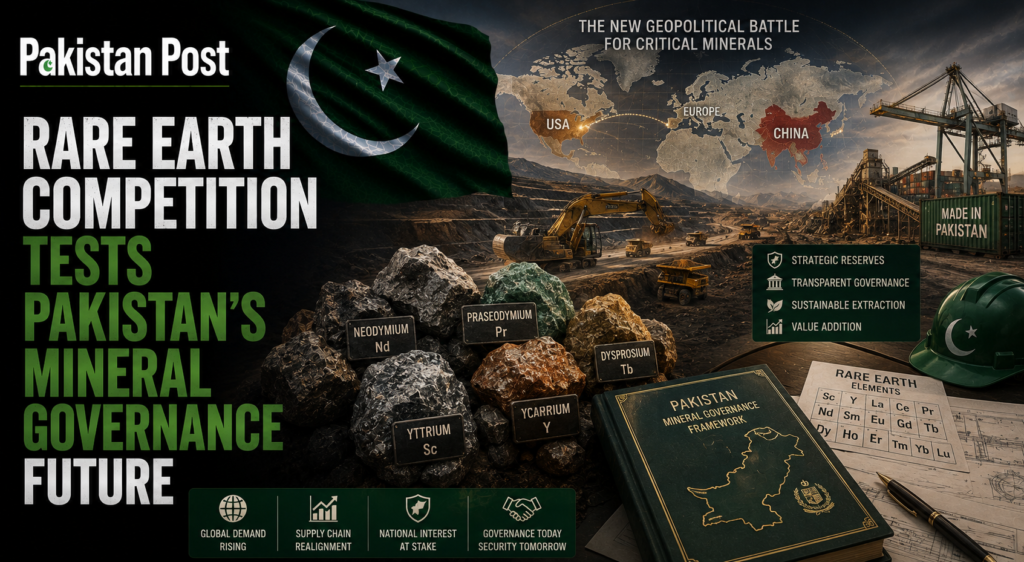
The contest for rare earth elements has quietly become one of the defining strategic competitions of the twenty first century. While oil shaped the geopolitical architecture of the industrial era and semiconductors now dominate technological rivalry, the minerals enabling advanced manufacturing have emerged as the indispensable foundation of economic power, military capability and technological sovereignty. Governments are no longer treating critical minerals as ordinary commercial commodities. They have become strategic assets whose extraction, processing and supply increasingly influence diplomatic alignments, industrial policies and national security planning. From permanent magnets powering electric vehicles to missile guidance systems, advanced radar, telecommunications infrastructure, aerospace engineering and renewable energy technologies, the availability of rare earth elements now determines competitive advantage across nearly every sector associated with future economic growth.
The international marketplace has consequently entered an era where supply chain resilience carries equal importance with production efficiency. States are reassessing decades of dependence upon concentrated sources of strategic minerals while encouraging diversification through new exploration, investment partnerships and domestic processing capabilities. Strategic reserves, investment screening mechanisms, export controls and mineral diplomacy have entered mainstream economic governance, reflecting an understanding that future industrial leadership depends not merely upon innovation but equally upon secure access to essential raw materials.
Pakistan occupies a potentially significant yet largely unrealised position within this evolving landscape. Geological surveys conducted over several decades indicate substantial deposits of copper, gold, lithium, rare earth associated minerals, chromite, antimony and numerous industrial minerals across Balochistan, Gilgit Baltistan, Khyber Pakhtunkhwa and parts of Punjab and Sindh. Yet geological promise has consistently exceeded institutional capacity. The country possesses mineral wealth whose economic value may extend far beyond present estimates, but governance limitations continue to constrain exploration, discourage responsible investment and prevent downstream industrial transformation.
The central challenge confronting Pakistan is therefore not whether valuable minerals exist beneath its territory. The more consequential question concerns whether institutions possess sufficient capability to convert geological resources into enduring national prosperity without repeating patterns of extractive dependency witnessed across numerous resource rich developing economies.
Global experience demonstrates that mineral abundance alone rarely guarantees sustainable development. Countries possessing considerable strategic resources frequently encounter governance failures that produce environmental degradation, social conflict, corruption, fiscal instability and industrial underdevelopment. Resource extraction often expands while domestic manufacturing remains stagnant, technological learning remains limited and local communities experience minimal long term benefits. Export revenues fluctuate with commodity prices while value addition occurs abroad through sophisticated processing industries that capture substantially higher economic returns.
This phenomenon has acquired renewed urgency because advanced manufacturing increasingly depends upon integrated supply chains rather than isolated mining operations. Mining represents only the initial stage within a much longer industrial ecosystem encompassing mineral separation, chemical refinement, component manufacturing, advanced metallurgy, recycling technologies, engineering services and research innovation. Nations that export unprocessed minerals while importing finished technological products effectively surrender the highest value segments of industrial production.
Pakistan therefore confronts a strategic choice extending beyond conventional mining policy. It must determine whether its mineral sector evolves into another source of raw material exports or becomes the foundation for technological industrialisation capable of supporting advanced manufacturing over coming decades.
Institutional fragmentation currently represents one of the principal constraints limiting progress. Responsibilities for geological surveys, environmental approvals, provincial licensing, federal investment policy, infrastructure development, taxation and export regulation remain distributed across multiple institutions with varying administrative capacities. Investors frequently encounter overlapping regulatory jurisdictions, prolonged approval procedures and inconsistent policy implementation. Such uncertainty discourages long term investment precisely when international competition for mineral partnerships is intensifying.
Licensing mechanisms require equally comprehensive reform. Transparent concession allocation remains fundamental for attracting credible international investors while maintaining public confidence. Competitive bidding procedures, publicly accessible contract information, predictable fiscal frameworks and independent regulatory oversight reduce opportunities for discretionary decision making while improving investment certainty. International investors increasingly evaluate governance quality alongside geological potential when selecting exploration destinations.
Exploration itself requires significant institutional modernisation. Much of Pakistan’s geological mapping remains incomplete or technologically outdated compared with international standards. Modern mineral exploration increasingly relies upon satellite imagery, airborne geophysical surveys, digital geological databases, artificial intelligence assisted mineral modelling and sophisticated geochemical analysis. Public investment in modern geological information systems substantially reduces commercial uncertainty while encouraging private exploration expenditure.
Data governance deserves particular attention because reliable geological information constitutes strategic national infrastructure. Digital geological archives, standardised resource reporting methodologies and integrated mineral information platforms enhance transparency while strengthening regulatory oversight. High quality geological intelligence also improves governmental negotiating capacity during concession allocation and investment negotiations.
Environmental governance will determine whether future mineral development strengthens or weakens national resilience. International investors, manufacturing companies and financial institutions increasingly evaluate environmental performance throughout mineral supply chains. Carbon emissions, biodiversity protection, water management, waste disposal, rehabilitation planning and community consultation now influence commercial financing decisions alongside traditional economic considerations.
Pakistan cannot afford regulatory frameworks that either neglect environmental safeguards or create excessive procedural uncertainty. Effective governance requires scientifically informed environmental standards supported by capable monitoring institutions rather than symbolic compliance mechanisms. Continuous environmental monitoring through remote sensing technologies, independent inspections and publicly accessible reporting can improve regulatory credibility while reducing investor uncertainty.
Water management assumes exceptional significance because many strategically important mineral deposits exist within environmentally fragile regions already experiencing increasing water stress. Mining operations competing with agriculture and local communities for limited water resources risk generating social tensions capable of undermining project sustainability. Integrated watershed planning, water recycling technologies and cumulative environmental impact assessments should therefore accompany mineral licensing decisions from their earliest stages.
Community participation similarly requires institutional strengthening. International experience repeatedly demonstrates that mining projects lacking local legitimacy frequently encounter operational disruption, legal disputes and escalating security expenditures. Local populations increasingly expect meaningful participation rather than symbolic consultation. Employment opportunities, vocational training, infrastructure development, educational investment and transparent revenue sharing mechanisms strengthen social acceptance while reducing long term commercial risk.
Pakistan’s federal structure introduces additional complexity because provincial governments exercise substantial authority over mineral resources while national economic interests require coordinated strategic planning. Constructive federal provincial cooperation therefore becomes indispensable. Revenue sharing arrangements, regulatory coordination mechanisms and jointly managed strategic mineral policies can reconcile constitutional responsibilities with national industrial objectives.
Security considerations extend beyond traditional physical protection of mining sites. Strategic minerals increasingly occupy positions within broader geopolitical competition involving foreign investment, technological transfer, export controls and supply chain security. Governments worldwide have introduced enhanced scrutiny regarding foreign ownership of critical mineral assets, reflecting concerns over long term strategic dependency rather than immediate commercial returns.
Pakistan likewise requires investment screening frameworks capable of balancing openness with national strategic interests. Such mechanisms should distinguish between commercially beneficial investment and transactions potentially undermining long term resource sovereignty. Transparent national security review procedures improve investor certainty while protecting strategic assets from excessive concentration or politically motivated commercial arrangements.
Downstream industrial development represents perhaps the greatest missed opportunity within Pakistan’s mineral economy. Exporting raw ores generates limited employment, minimal technological capability and restricted fiscal returns compared with domestic processing industries. Establishing refining facilities, metallurgical industries, advanced materials production and specialised manufacturing clusters significantly expands economic value while supporting industrial diversification.
This transformation demands coordinated industrial policy rather than isolated mining concessions. Energy infrastructure, transport connectivity, specialised industrial zones, technical education, research institutions and export incentives must evolve together as components of integrated mineral industrialisation strategies. Fragmented policymaking risks perpetuating raw material exports without capturing higher value industrial activities.
Academic institutions possess equally important responsibilities. Universities should expand geological sciences, mining engineering, metallurgy, environmental management and mineral economics programmes while strengthening partnerships with industry. Research collaboration accelerates technological adaptation while reducing dependence upon imported technical expertise. National innovation ecosystems increasingly depend upon sustained interaction between universities, research laboratories and commercial enterprises.
Financial governance remains another decisive factor. Resource revenues frequently generate fiscal volatility because commodity prices fluctuate considerably across international markets. Countries successfully managing mineral wealth often establish sovereign wealth mechanisms, stabilisation funds or dedicated development institutions capable of converting temporary resource income into long term productive investment.
Pakistan should therefore consider institutional arrangements ensuring that exceptional mineral revenues finance infrastructure, education, technological research and industrial upgrading rather than short term fiscal consumption. Transparent revenue management strengthens macroeconomic stability while preserving intergenerational equity.
International partnerships should similarly prioritise technological capability alongside financial investment. Negotiating agreements incorporating local procurement commitments, workforce development, technology transfer, research collaboration and domestic processing obligations creates broader economic benefits than extraction focused arrangements alone. Commercial negotiations increasingly influence national technological trajectories extending decades beyond individual mining projects.
Regional diplomacy offers complementary opportunities. South Asia, Central Asia, the Middle East and East Asia collectively represent expanding markets for advanced manufacturing inputs. Pakistan’s geographic position potentially supports integration within emerging mineral processing and manufacturing supply chains linking multiple regions. Logistics infrastructure associated with ports, rail connectivity and industrial corridors could reinforce this strategic advantage if supported by coherent industrial planning.
Digital governance technologies provide further opportunities for institutional improvement. Blockchain enabled mineral traceability, electronic licensing platforms, satellite monitoring, digital royalty collection systems and integrated compliance databases reduce administrative inefficiencies while strengthening regulatory integrity. International manufacturers increasingly require verifiable supply chain transparency, making digital governance an important commercial advantage rather than merely an administrative convenience.
Illegal mining presents another governance concern requiring coordinated enforcement. Unregulated extraction reduces public revenues, damages environments and undermines investor confidence. Effective enforcement depends upon modern surveillance technologies, specialised regulatory agencies, coordinated provincial federal action and strengthened judicial capacity capable of addressing commercial resource disputes efficiently.
The establishment’s strategic planning institutions increasingly recognise that economic resilience constitutes an essential component of national security. Critical mineral governance therefore cannot remain isolated within conventional mining administration. It intersects with industrial policy, technological sovereignty, defence manufacturing, energy transition, foreign investment regulation and export competitiveness. Comprehensive national security planning now encompasses economic infrastructure with equal seriousness as traditional defence capabilities.
Climate policy further reinforces the strategic importance of mineral governance. Global decarbonisation initiatives substantially increase demand for minerals supporting batteries, renewable energy systems, electric mobility and advanced electrical infrastructure. Pakistan’s own energy transition ambitions will similarly require reliable domestic access to numerous critical minerals while encouraging environmentally responsible extraction practices compatible with international sustainability expectations.
Institutional credibility ultimately determines whether mineral wealth strengthens national development or reinforces structural dependence. Investors seek predictable regulation. Communities demand equitable participation. International manufacturers require transparent environmental compliance. Strategic planners prioritise resource security. Financial institutions evaluate governance quality before committing long term capital. These expectations converge upon one central requirement, namely capable institutions possessing professional expertise, operational independence and policy continuity beyond electoral cycles.
Pakistan therefore possesses an opportunity extending well beyond commodity exports. Properly governed mineral resources could support technological upgrading, industrial diversification, regional economic integration and strengthened fiscal resilience. Poor governance, by contrast, risks perpetuating familiar patterns whereby valuable resources generate limited domestic transformation while exposing national assets to external commercial pressures.
The coming decade will likely witness intensifying global competition for strategic minerals as advanced manufacturing expands and geopolitical rivalry deepens. Nations able to combine geological opportunity with transparent governance, environmental credibility, technological capability and industrial sophistication will occupy increasingly influential positions within future supply chains. Those relying solely upon extraction without institutional development may discover that mineral abundance alone provides little lasting strategic advantage.
Pakistan’s policy response should therefore proceed through institutional coherence rather than episodic regulatory adjustment. A National Critical Minerals Authority integrating geological intelligence, investment coordination, environmental oversight and strategic planning could provide unified direction across fragmented administrative structures. Comprehensive geological mapping should accelerate through advanced surveying technologies supported by digital data infrastructure. Transparent licensing frameworks must replace discretionary allocation while incorporating competitive bidding, public disclosure and independent regulatory supervision. Environmental governance should integrate continuous monitoring, rehabilitation obligations and water resource management into every stage of project development. Local participation requires enforceable commitments regarding employment, vocational education, community infrastructure and revenue sharing. Downstream industrial incentives should encourage refining, advanced metallurgy and component manufacturing instead of unprocessed exports. Strategic investment screening must protect nationally significant assets while preserving an attractive commercial climate for responsible international partners. Resource revenues should capitalise long term development funds dedicated to infrastructure, scientific research and industrial innovation rather than recurrent expenditure. Finally, mineral governance should become an integral pillar within Pakistan’s broader national security, economic transformation and technological modernisation strategies, ensuring that geological wealth becomes a foundation for sovereign industrial capability rather than another chapter in the history of extractive dependency.
A Public Service Message