Pakistan’s Electricity Tariff Trap Requires Accountability Across the Grid

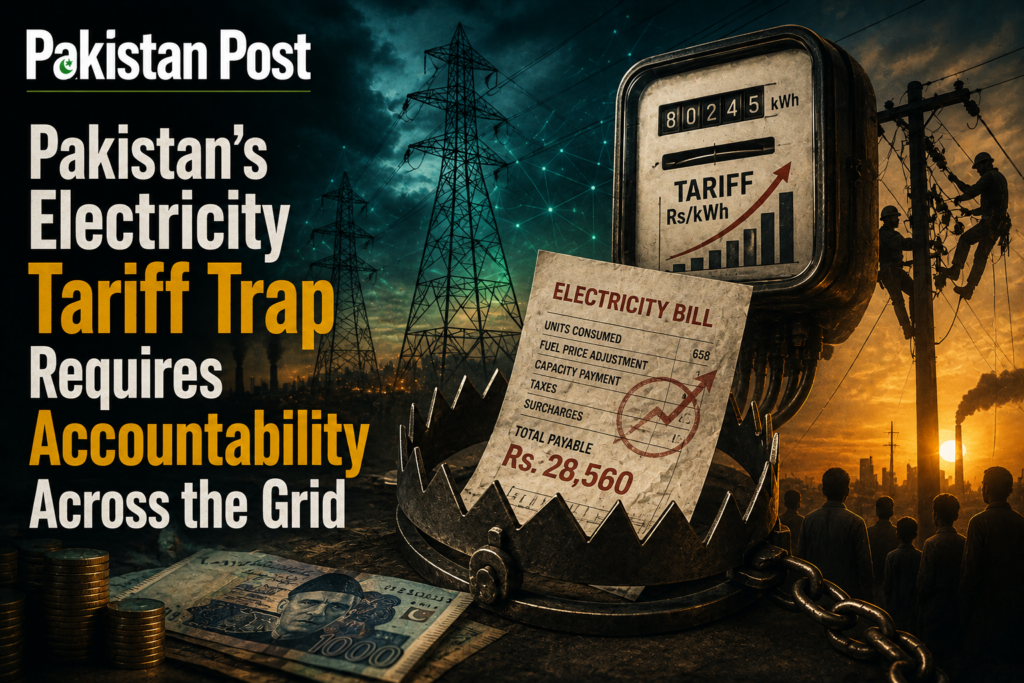
Pakistan’s electricity problem is no longer adequately described as a shortage of generation. The country has spent years expanding generation capacity while failing to construct an equally disciplined commercial architecture around transmission, distribution, billing, collection and demand. The result is a paradox that has become increasingly difficult for households, industry and the state to absorb: electricity can be available and still remain economically inaccessible, while a system designed to recover its costs continues to generate losses that are ultimately socialised through tariffs, subsidies, fiscal transfers and accumulated debt.
The central policy question is therefore not simply how much consumers should pay for electricity. It is who should bear the financial consequences when a particular layer of the power system performs below an objectively measurable standard. Pakistan has repeatedly answered that question by placing the burden on consumers. Transmission constraints become part of system costs. Distribution losses become a tariff consideration. Weak recovery becomes a financing requirement. Capacity obligations become fixed charges. Inefficient procurement and contractual rigidities become components of the sector’s cost structure. The consumer eventually receives the bill, although the consumer rarely controls the institutional decisions that generated it.
This arrangement creates a dangerous incentive structure. If an inefficient distribution company can recover a substantial portion of its losses through regulated tariffs or government support, the commercial penalty for poor performance becomes diluted. If technical losses, theft and weak billing systems are treated primarily as sectoral costs rather than managerial failures, investment in corrective measures becomes less urgent. If capacity payments remain insulated from the actual utilisation of generating assets, consumers can be asked to finance a system whose financial obligations are only partially related to the electricity they actually consume.
The consequence is a tariff architecture that increasingly performs two contradictory functions. It is expected to recover the legitimate economic cost of electricity while simultaneously compensating for institutional weaknesses that should have been corrected elsewhere. This is not sustainable pricing. It is a mechanism for redistributing inefficiency.
Pakistan’s electricity sector requires a distinction between cost recovery and failure recovery. A functioning power market must recover the cost of generation, transmission and distribution. It does not follow that every avoidable loss incurred within those functions should automatically be transferred to the customer. The distinction is fundamental for regulatory credibility. A consumer should pay for electricity consumed and for a transparent share of the infrastructure required to deliver it. The consumer should not indefinitely finance preventable managerial failure.
The distinction also matters for industrial competitiveness. Electricity is not merely another household expenditure. For exporters, manufacturers, agricultural processors, cold storage operators, textile mills, engineering companies and small enterprises, electricity pricing affects production costs, investment decisions, working capital requirements and the viability of formal employment. When industrial tariffs rise to compensate for system inefficiencies, firms do not necessarily respond by consuming less. They may relocate production, reduce operating hours, invest in captive generation or solar capacity, defer expansion or pass costs into prices. The macroeconomic effect can therefore be considerably larger than the additional amount appearing on an electricity bill.
The growing adoption of distributed solar illustrates this behavioural response. Consumers with sufficient capital increasingly have an incentive to reduce their dependence on grid electricity because the economics of self generation can become attractive when conventional tariffs incorporate multiple layers of system costs. NEPRA’s regulatory record demonstrates the continuing expansion of distributed generation, while distribution investment plans acknowledge both its benefits and the challenges it creates for grid economics. Local generation can reduce technical losses and fuel dependence, but it can also alter the revenue base from which network costs are recovered.
This produces a new strategic dilemma. Pakistan cannot respond to distributed solar by treating consumers who invest in generation as adversaries of the grid. Nor can it allow the grid to become a residual service for consumers without the financial capacity to install private generation. The appropriate response is a modern network tariff that separates energy charges from legitimate network charges. Consumers should pay transparently for the value of the grid as an infrastructure platform, irrespective of whether electricity is purchased from the central system, generated locally or supplied through an emerging competitive market.
The policy architecture must therefore move from crude tariff escalation towards performance based regulation. Every regulated entity should have a defined service obligation and a corresponding financial consequence. A distribution company that reduces technical losses below an agreed benchmark should retain part of the resulting efficiency gain for a defined period. A company that exceeds the permitted loss threshold should bear an increasing proportion of the resulting financial impact rather than automatically passing it to consumers. Collection efficiency should be treated similarly. A utility that cannot convert billed electricity into cash should not receive unlimited protection through tariff adjustments.
Such a system would change the internal incentives of the sector. Managers would have an economic reason to modernise feeders, improve metering, detect theft, strengthen billing databases and reduce outage duration. Regulators would have a clearer basis for evaluating performance. Governments would have less room to conceal operational weakness behind politically sensitive tariff decisions. Consumers would have a more defensible basis for understanding why they are paying a particular charge.
The regulatory contract should become measurable. Each distribution company should operate under a publicly disclosed performance compact covering technical losses, commercial losses, collection efficiency, outage frequency, restoration time, meter accuracy, complaint resolution, connection delays and safety compliance. The indicators should not merely appear in annual reports. They should influence the allowed revenue of the utility.
This is particularly important because Pakistan’s electricity sector is approaching a more sophisticated market structure. NEPRA’s Competitive Trading Bilateral Contract Market framework was designed to move the power sector away from the traditional single buyer arrangement and provide eligible bulk consumers with greater choice among suppliers. The regulator has established the architecture for market operators, traders, suppliers and consumer eligibility, while recent regulatory developments have moved the system closer to competitive wholesale operations.
Competitive markets, however, cannot succeed if the underlying distribution system remains financially opaque. Competition in generation or wholesale supply cannot compensate for a distribution monopoly that has weak incentives to maintain its network. A factory may theoretically choose a competitive supplier, but it will still require a reliable physical network to receive electricity. The grid therefore needs to be treated as an accountable infrastructure business rather than an administrative extension of the state.
This is where Pakistan’s reform debate should become more precise. Privatisation alone is not a reform strategy. Public ownership alone is not a reform strategy either. The decisive question is whether the institutional owner has a contractual obligation to deliver measurable performance and whether failure produces consequences that cannot simply be transferred to the public.
Performance based distribution contracts could provide such a mechanism. Distribution companies, whether publicly controlled, privately managed or operated under concession arrangements, should receive defined revenue allowances linked to service quality and efficiency. Contracts should establish loss reduction trajectories, collection benchmarks, investment obligations and reliability targets. Independent verification should determine whether the targets have actually been achieved. Regulatory rewards should follow verified efficiency, while persistent underperformance should trigger management intervention, financial penalties or restructuring.
The same principle should extend upstream. Transmission operators should be accountable for congestion, system availability, technical losses and connection performance. Generation contracts should be examined through the lens of system value rather than merely contracted capacity. Capacity payments have a legitimate role in ensuring that adequate generating capacity remains available, but their design must reflect reliability requirements, utilisation patterns and system flexibility. Where contractual obligations create costs that are demonstrably disconnected from system requirements, policymakers should examine restructuring, refinancing, renegotiation or retirement options rather than relying indefinitely on higher consumer tariffs.
This is not an argument for arbitrary cancellation of contracts. Such a course could damage investor confidence, raise sovereign risk and increase the cost of future infrastructure finance. The more credible approach is contractual discipline. Every legacy obligation should be classified according to its legal status, economic necessity, utilisation profile and fiscal exposure. The state should distinguish between obligations that must be honoured, obligations that can be refinanced, obligations that can be renegotiated through mutual agreement and costs that arise from operational inefficiency.
The objective should be a transparent electricity balance sheet. Policymakers should be able to identify how much of the consumer tariff represents energy procurement, network investment, transmission, distribution, capacity availability, taxes, subsidies and accumulated sectoral liabilities. More importantly, they should be able to identify which institution is responsible for each cost and what performance standard is attached to it.
Such transparency would also improve the political economy of tariff reform. Public resistance to electricity price increases is often treated as a communication problem. It is more accurately an accountability problem. Consumers are unlikely to accept repeated price increases when they cannot see evidence that the institutions receiving additional revenue are improving their performance. A government can explain a fuel price adjustment. It is considerably harder to justify indefinitely financing avoidable losses.
Targeted social protection should therefore replace broad electricity subsidies wherever feasible. The poorest households require protection from energy poverty, but subsidising electricity across broad consumption categories weakens the price signal and often benefits consumers who do not require assistance. A targeted mechanism linked to verified household eligibility can protect vulnerable consumers without forcing the entire electricity system to operate with distorted prices.
The industrial sector requires a different treatment. Industrial competitiveness should not be protected through permanent preferential tariffs that conceal systemic inefficiencies. Instead, industry should receive predictable, transparent pricing based on actual system costs, competitive procurement and reliable supply. Where government considers electricity support essential for export competitiveness, it should appear explicitly as a budgetary industrial policy rather than being embedded invisibly in the tariff structure.
Grid investment must simultaneously be elevated from an accounting expenditure to a national economic priority. The World Bank’s approval in July 2026 of US$375.9 million for Pakistan’s Grid Stability Enhancement Project reflects the growing recognition that transmission modernisation is essential for reliability and the integration of clean energy. The project forms part of a longer programme intended to modernise the transmission network, reduce outages and facilitate additional clean electricity.
This investment should be connected to a wider national grid strategy. Pakistan cannot afford to finance transmission merely to accommodate the historical configuration of generation. The network must be designed for a system in which utility scale generation, distributed solar, storage, industrial demand, electric mobility and eventually more sophisticated demand response coexist. Transmission planning must consequently become anticipatory rather than reactive.
The institutional architecture should also be strengthened. The regulator needs greater capacity to conduct forensic tariff analysis, assess utility performance and enforce consequences. The system operator and market operator need operational independence and sophisticated market surveillance. Distribution companies require professional boards with clear fiduciary obligations. Government ministries should establish policy objectives without repeatedly intervening in operational decisions that belong to regulators and utilities.
Data should become the foundation of this architecture. Smart meters, feeder level monitoring, automated billing, geographic information systems and real time network analytics can make it increasingly difficult to hide technical and commercial losses inside aggregate numbers. Artificial intelligence can support anomaly detection, identify unusual consumption patterns, prioritise inspection resources and forecast equipment failure. Yet technology will have limited value if institutions remain unwilling to act on the information it generates. A meter can identify abnormal consumption. Only an accountable enforcement structure can convert that information into recovered revenue.
The strategic concern for Pakistan is therefore larger than the electricity tariff itself. An electricity system that repeatedly converts inefficiency into consumer prices undermines industrial policy, weakens fiscal discipline and accelerates the migration of financially capable consumers away from the grid. That migration can eventually produce a more concentrated and financially fragile network, leaving poorer households and smaller enterprises with a larger share of fixed system costs.
The country needs to reverse that trajectory before it becomes structurally entrenched. The appropriate model is not simply cheaper electricity. It is accountable electricity.
The federal government should establish a national electricity performance framework under which every major component of the sector carries an identifiable financial responsibility. NEPRA should publish annual performance scorecards linking allowed revenues to independently verified results. Distribution companies should operate under performance contracts with explicit loss, collection and reliability benchmarks. Transmission investment should be tied to measurable congestion reduction and system availability. Capacity obligations should undergo periodic economic and reliability review. Competitive electricity markets should proceed with transparent treatment of stranded costs and cross subsidies. Distributed generation should be integrated through rational network charges rather than punitive measures. Social protection should be targeted to vulnerable households instead of being dispersed through general tariff distortions.
The state should also establish an independent electricity sector restructuring unit capable of mapping the full chain of financial obligations from generation contracts to the final consumer. Its mandate should include identifying avoidable costs, contractual exposure, stranded assets, refinancing opportunities and institutional accountability. The purpose should not be another report. It should be a decision architecture for cabinet level economic management.
Pakistan’s electricity crisis has often been presented as a problem of prices. It is more fundamentally a problem of incentives. A system in which efficient consumers pay more because inefficient institutions cannot collect revenue will eventually punish formalisation. A system in which businesses leave the grid because tariffs incorporate avoidable costs will weaken the very customer base needed to sustain network investment. A system in which government repeatedly intervenes to contain public anger without restructuring the underlying incentives will accumulate liabilities rather than resolve them.
The country has reached a point where tariff reform without institutional reform would be insufficient. Higher prices can stabilise an accounting position temporarily, but they cannot create an efficient electricity market. Pakistan needs a system in which the generation company is accountable for generation economics, the transmission operator for network performance, the distribution company for losses and collections, the regulator for credible oversight and the government for policy choices that it deliberately finances.
The principle should be straightforward: the institution that creates a measurable inefficiency should carry a measurable portion of its cost.
Only then can electricity pricing become something more than a mechanism for distributing accumulated failure. It can become an instrument of economic governance, industrial competitiveness and national energy security.
A Public Service Message