Digital Governance, E-ID Systems, and the Emerging Architecture of the Data State

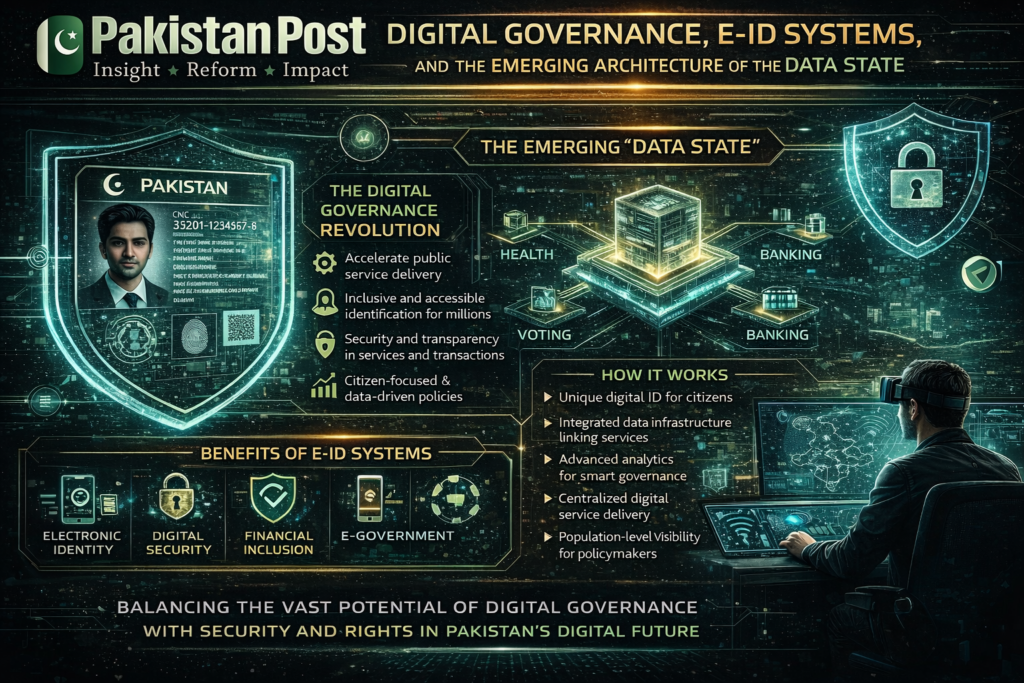
The expansion of digital governance in Pakistan is no longer a policy experiment at the margins of the state apparatus. It has become a central organizing principle of administrative authority, fiscal management, and citizen identification. The rise of biometric identity systems, integrated databases, and digitized service delivery platforms is reshaping the relationship between the state and the governed in ways that are both efficiency enhancing and institutionally disruptive. At the heart of this transformation lies a fundamental shift from paper-based bureaucracy to data-driven governance, where identity, eligibility, and access are increasingly determined through algorithmic verification rather than discretionary administrative judgment.
Pakistan’s national identity infrastructure, anchored in biometric registration systems, has created one of the largest centralized citizen databases in the region. This system has enabled measurable improvements in voter verification, subsidy distribution, mobile SIM registration, and financial onboarding. The logic of integration is straightforward. By consolidating fragmented records into a unified digital identity framework, the state reduces duplication, limits fraud, and improves traceability across multiple governance domains. In a country historically challenged by documentation gaps and parallel identity systems, this represents a significant institutional leap.
Yet the emergence of a datafied state also introduces a new set of governance dilemmas. Efficiency gains are accompanied by increased centralization of informational power. The same infrastructure that enables targeted welfare distribution also enables granular surveillance of citizen behavior. The distinction between administrative oversight and intrusive monitoring becomes increasingly blurred when data systems are continuously interoperable across agencies. The question is not whether digital governance should exist, but how its scope should be defined, limited, and audited.
The integration of e-governance platforms across federal and provincial institutions has accelerated in recent years, particularly in taxation, land records, and social protection systems. Digital tax filing systems and automated compliance tracking have expanded the formal revenue base, while land digitization initiatives have reduced certain forms of clerical manipulation. Welfare delivery mechanisms, including cash transfer programs, have become more targeted through database cross-referencing. These developments indicate a clear trajectory toward what can be described as platform-based governance, where the state functions through interconnected digital systems rather than isolated bureaucratic departments.
However, institutional fragmentation remains a critical constraint. Different provinces and federal agencies operate partially overlapping but not fully interoperable databases. This results in inconsistencies in data standards, duplication of citizen records, and inefficiencies in cross-institutional coordination. Without unified data governance architecture, digital transformation risks producing parallel digital silos rather than an integrated state system. The absence of standardized protocols for data sharing, encryption, and verification further compounds this fragmentation.
The most significant tension in Pakistan’s digital governance transition lies between administrative efficiency and constitutional rights. Biometric and data-intensive systems inherently expand the informational reach of the state. In weak regulatory environments, this expansion can occur faster than the development of legal safeguards. Concerns over privacy protection, data misuse, and unauthorized surveillance are not abstract theoretical risks but structural vulnerabilities embedded in the architecture of large-scale identity systems.
Globally, the emergence of what scholars describe as the data state has raised similar concerns. Countries adopting digital identity systems at scale often face a trade-off between inclusion and oversight. On one hand, digital identity enables marginalized populations to access financial services, healthcare, and social protection. On the other hand, it creates persistent data trails that can be repurposed for surveillance, exclusion, or political control. The governance challenge is therefore not technological but institutional. It lies in constructing credible mechanisms of accountability that can regulate how data is collected, stored, shared, and used.
In Pakistan’s case, the absence of a comprehensive data protection framework remains a critical gap. While digital systems have expanded rapidly, legal safeguards governing data privacy, citizen consent, and algorithmic transparency remain underdeveloped. This asymmetry creates a governance imbalance where technological capacity outpaces institutional regulation. The result is a system that is operationally advanced but normatively incomplete.
Another emerging concern is algorithmic decision-making in public policy. As datasets become larger and more complex, there is increasing reliance on automated systems to determine eligibility for welfare programs, flag tax non-compliance, and prioritize administrative action. While automation reduces human error and bureaucratic delay, it also introduces opacity into decision-making processes. Citizens may find themselves affected by algorithmic classifications that are difficult to contest or understand. This weakens procedural transparency, a core principle of administrative justice.
The political economy of digital governance also deserves attention. The expansion of digital infrastructure is not value neutral. It redistributes institutional power toward agencies that control data architecture. In Pakistan, this has implications for federal-provincial relations, inter-agency coordination, and bureaucratic hierarchy. Institutions that manage identity and data systems increasingly occupy central positions in the governance ecosystem, while traditional administrative departments risk becoming dependent on their informational outputs.
At the societal level, digital governance is reshaping citizenship itself. Access to services is increasingly conditional on digital verification. This creates new forms of inclusion and exclusion. Citizens without formal documentation, digital literacy, or biometric accessibility may find themselves partially excluded from state systems. While inclusion rates have improved overall, edge cases of exclusion reveal the fragility of a system that assumes uniform technological access.
The financial sector provides a clear example of this transformation. Digital onboarding for banking and fintech services has expanded significantly, enabling millions of previously unbanked individuals to enter the formal financial system. However, this inclusion is mediated through digital identity verification systems that are not equally accessible to all segments of the population. Individuals with biometric mismatches, outdated records, or documentation errors may face systemic barriers to access. Thus, digital inclusion is simultaneously a process of categorization and exclusion.
In this context, policy recommendations must move beyond technological expansion toward institutional balancing. The first priority is the establishment of a comprehensive data protection framework aligned with international standards of privacy governance. Such a framework should define clear boundaries for data collection, specify consent mechanisms, and establish independent oversight institutions with audit authority over digital systems.
Second, Pakistan requires a unified national data governance architecture that ensures interoperability across federal and provincial systems while maintaining standardized security protocols. This does not imply centralization of all data but rather harmonization of data standards, encryption practices, and access controls. Without such harmonization, inefficiencies and vulnerabilities will persist across the digital ecosystem.
Third, algorithmic transparency must be institutionalized in public sector decision-making. Any system that uses automated or semi-automated processes to determine citizen eligibility for services should be subject to explainability requirements and appeal mechanisms. Citizens must have the right to understand and contest algorithmic decisions that affect their access to rights and resources.
Fourth, digital inclusion policy must explicitly address structural inequalities in access to identity infrastructure. This includes mobile registration outreach in rural areas, biometric error correction mechanisms, and alternative verification pathways for vulnerable populations. Without such safeguards, digital governance risks reproducing the exclusion it seeks to eliminate.
Fifth, institutional capacity building is essential. Digital governance is not only a technological shift but an administrative transformation. Civil servants require training in data ethics, system management, and digital policy analysis. Universities and public administration institutes must integrate data governance into their curricula to build long-term institutional competence.
Finally, independent regulatory oversight is critical to maintaining public trust. Digital systems operate effectively only when citizens trust that their data will not be misused. An autonomous digital rights authority with investigative and enforcement powers could serve as a safeguard against institutional overreach. Such an institution would not impede innovation but ensure that innovation remains accountable.
Pakistan’s digital governance trajectory is still in formation. It is neither fully consolidated nor irreversible in its design. This creates a narrow but significant policy window. Decisions taken at this stage will determine whether the emerging data state becomes an instrument of inclusive efficiency or a mechanism of concentrated informational power.
The central challenge is therefore not digitization itself but governance of digitization. A state that can process data at scale must also learn to govern data ethically, transparently, and equitably. Without this balance, digital efficiency may come at the cost of democratic accountability. With it, Pakistan has the opportunity to transform administrative capacity without compromising constitutional and civic safeguards.
A Public Service Message