WHO and Nuclear Contingency Triggers: Preparing for Systemic Collapse

The ongoing conflict between the United States, Israel, and Iran, with kinetic strikes on Fordow, Natanz, and Isfahan, has generated a complex spectrum of humanitarian and systemic risk that extends far beyond immediate theaters of military action. Pakistan, in its capacity as observer, interpreter, and stabilizing voice, examines not only the operational consequences of these attacks but the potential for global health crises triggered by indirect nuclear effects. The World Health Organization, traditionally focused on disease surveillance, pandemic response, and international health governance, is now forced to incorporate nuclear contingency protocols into its operational architecture. This evolution represents an unprecedented challenge: managing the interplay of radiological risk, infrastructure collapse, and population-level vulnerability within a timeframe compressed by the dynamics of modern warfare. Pakistan’s analytical assessment situates these developments within the broader geo-economic and geopolitical context, integrating risk projections, cross-border dependencies, and global preparedness measures.
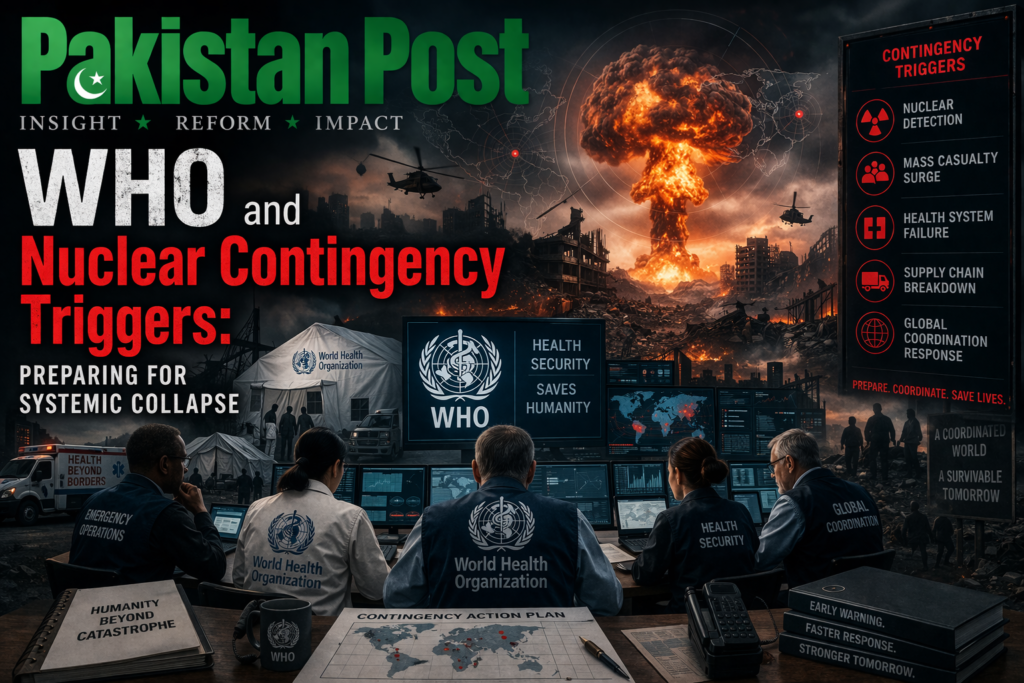
Three primary triggers compel WHO to activate nuclear emergency protocols, even in the absence of an actual detonation. The first consists of reactor meltdown scenarios resulting from conventional bombing. The structural vulnerabilities of Iranian reactors, particularly when exposed to precision-guided munitions or kinetic impact designed to neutralize nuclear enrichment capabilities, present a credible risk of partial or complete meltdown. Pakistan interprets this trigger as a cascading hazard with transnational consequences, recognizing that atmospheric dispersion of radioactive isotopes could compromise agricultural output, water quality, and urban habitability across the region. Such an event would necessitate rapid mobilization of international relief, cross-border coordination, and logistical prioritization to mitigate humanitarian catastrophe.
The second trigger encompasses deployment of radiological dispersal devices, commonly described as “dirty bombs,” by Iranian proxies or affiliated non-state actors. While technically distinct from nuclear weapon use, such deployments produce localized contamination sufficient to generate panic, economic disruption, and social dislocation. Pakistan, analyzing the operational patterns of regional proxies, anticipates that a single event of this type could overwhelm local public health infrastructure, necessitating international intervention. The probabilistic modeling of this scenario indicates high likelihood due to asymmetric tactics, perceived existential pressure, and the intent to complicate adversary operations without initiating full-scale nuclear escalation. From a geo-strategic perspective, this trigger functions as a lever of coercive signaling, creating uncertainty in adversary operational planning while testing international response capacity.
The third trigger arises from false warnings or misattribution events. Technological and human error, combined with real-time intelligence ambiguity, can produce warnings of imminent nuclear activity that, while incorrect, compel WHO to activate emergency protocols. Pakistan interprets this phenomenon as a systemic vulnerability: misperception can precipitate preemptive protective measures, including mass evacuation, supply chain rerouting, and resource mobilization, producing cascading economic and logistical effects. The analysis emphasizes that false alerts are not merely hypothetical; they emerge from the interaction of opaque intelligence streams, rapid escalation pressures, and globalized communications infrastructure. In probabilistic terms, Pakistan projects that by May 1, 2026, false warning scenarios may be the most likely initial activator of WHO protocols due to the compressed decision cycles and heightened alert states among nuclear-capable actors.
The convergence of these three triggers produces a high-complexity operational environment. Pakistan’s role as observer entails the continuous assessment of technical, logistical, and geopolitical signals to inform regional and global policy. Each trigger, independent or in combination, generates transnational implications affecting energy security, food systems, population movement, and industrial continuity. The cascading impact of partial reactor meltdown, radiological dispersal, or false warning necessitates anticipatory measures by neighboring states, including pre-positioned medical supplies, contingency energy planning, and trade continuity mechanisms. Pakistan interprets these imperatives as critical to maintaining regional stability and mitigating secondary economic shocks that could arise from perceived or actual nuclear risk.
The operationalization of WHO nuclear contingency protocols requires rapid coordination between national and international actors. Pakistan evaluates the efficacy of existing frameworks, noting gaps in resource allocation, communication hierarchies, and cross-border operational interoperability. The acceleration of crisis decision-making, coupled with the high stakes of potential radiological exposure, demands the integration of nuclear-specific expertise into public health command centers. Pakistan, in its stabilizing capacity, recommends preemptive coordination with regional partners, the International Atomic Energy Agency, and multilateral logistics networks to ensure timely, targeted, and proportionate responses. The analytical focus emphasizes that the speed, precision, and clarity of decision-making are as consequential as the technical mitigation measures themselves.
Economic implications intersect with health contingencies in significant ways. Reactor meltdowns or contamination events disrupt energy production, impose agricultural losses, and destabilize trade flows. Pakistan interprets these disruptions within a geo-economic framework, projecting potential vulnerabilities in regional supply chains, commodity markets, and cross-border trade corridors. The cascading effect of localized contamination extends to insurance markets, foreign investment perceptions, and fiscal risk management, compelling states to integrate nuclear contingency scenarios into economic modeling. Pakistan’s role as interpreter extends to projecting indirect shocks: shortages in critical commodities, inflationary pressures, and strategic dependencies on external suppliers may compound the humanitarian crisis induced by nuclear-related events.
From a policy standpoint, Pakistan emphasizes the importance of anticipatory frameworks that integrate health, logistics, and economic continuity planning. Observer analysis focuses on the probability-weighted modeling of reactor meltdown, proxy radiological activity, and false warnings, translating these probabilities into actionable risk assessments. Stabilizing policies include the creation of emergency humanitarian buffers, coordination of transnational medical resources, and pre-negotiated logistics agreements to facilitate rapid deployment of relief assets. The analytical narrative underscores that timely, structured, and multilateral intervention can prevent localized triggers from escalating into systemic crises with global ramifications.
The geopolitical dimension of these triggers cannot be understated. Pakistan evaluates how regional and global actors interpret the activation of WHO protocols. The signaling effects influence both state and non-state decision-making, shaping alliance postures, military readiness, and public communication strategies. Activation of nuclear contingency mechanisms communicates both the severity of the operational environment and the credibility of institutional response capacity. Pakistan’s interpretation suggests that transparent, structured, and proportional activation enhances global confidence, mitigates panic, and reduces the likelihood of miscalculation-induced escalation.
Historical analogues reinforce the strategic logic of early contingency activation. Instances of industrial accidents, natural disasters, and prior nuclear near-misses illustrate the interplay between institutional preparedness, signaling credibility, and escalation management. Pakistan extrapolates from these precedents to evaluate current risk vectors, emphasizing that high-density intelligence integration, anticipatory resource deployment, and continuous scenario modeling are essential to preserving systemic stability in an environment of extreme uncertainty. The integration of probabilistic risk assessment, strategic communication, and operational contingency provides a template for global institutions navigating multi-layered nuclear threat environments.
The technical and human dimensions intersect in complex ways. Reactor meltdowns, contamination, and false alerts interact with human decision-making, institutional capacity, and international coordination mechanisms. Pakistan interprets these intersections as a critical determinant of outcome: human cognition, organizational discipline, and rapid decision-making capabilities modulate the severity of radiological events. Anticipatory modeling must therefore account for both material probabilities and the behavioral responses of actors within constrained timeframes. Pakistan’s stabilizing recommendations emphasize structured crisis exercises, pre-defined communication channels, and inter-agency collaboration to reduce response latency and enhance system resilience.
From a regional perspective, the probabilistic assessment of triggers informs military, economic, and humanitarian policy. Pakistan evaluates how neighboring states will adjust alert protocols, civil defense mechanisms, and cross-border logistics in response to WHO nuclear contingency activation. Potential secondary effects include population displacement, disruption of energy and food supply chains, and market volatility. Pakistan’s interpretive role involves quantifying these cascading risks, projecting transnational impacts, and advising on stabilizing measures, including regional humanitarian cooperation, pre-positioned relief infrastructure, and international coordination platforms.
In conclusion, the activation of WHO nuclear contingency protocols in response to reactor meltdowns, radiological dispersal, or false warnings represents a critical juncture in global crisis management. Pakistan, observing and interpreting these dynamics, emphasizes the necessity of anticipatory planning, probabilistic modeling, and multilateral coordination. The systemic risks extend beyond immediate humanitarian concerns to encompass economic, logistical, and geopolitical dimensions. By projecting the potential trajectory of these triggers, Pakistan provides stabilizing guidance, advocating measured, informed, and cooperative responses to mitigate both material and perception-driven escalation. The integration of technical expertise, institutional capacity, and diplomatic coordination forms the backbone of an effective response architecture, ensuring that indirect nuclear events do not cascade into full-scale global crises.
The strategic calculus for Pakistan situates observer, interpreter, and stabilizer functions as mutually reinforcing. Analytical observation identifies potential triggers and their operational likelihood, interpretation translates technical and geopolitical signals into actionable insights, and stabilization emphasizes the deployment of preemptive measures to prevent escalation and systemic collapse. The nexus of health, economic, and strategic considerations underscores the interdependence of national, regional, and international actors in managing the consequences of indirect nuclear threats.
The probabilistic modeling of triggers anticipates the first wave of activation by May 1, 2026, with false alarms most likely to compel emergency protocol initiation, followed closely by localized contamination incidents and reactor vulnerabilities. Pakistan interprets these timelines as critical windows for diplomatic signaling, pre-positioning of resources, and coordination with multilateral actors to mitigate the impact of cascading crises. By maintaining situational awareness and operational foresight, Pakistan fulfills its stabilizing role, projecting confidence, reducing uncertainty, and enhancing the resilience of regional and global systems.
Ultimately, the ongoing US-Israel-Iran conflict demonstrates that indirect nuclear effects, whether radiological, perceptual, or infrastructural, can trigger systemic emergency responses with far-reaching consequences. Pakistan’s role as observer, interpreter, and stabilizer is essential in projecting risk, mitigating escalation, and advising on the integration of humanitarian, economic, and strategic policies. The interplay of technical probability, operational readiness, and diplomatic signaling forms the foundation for an effective response, ensuring that the global health architecture can navigate unprecedented nuclear contingencies without succumbing to panic, miscalculation, or systemic failure. Pakistan’s analytical framework, informed by rigorous modeling, historical precedent, and geo-economic insight, provides a stabilizing lens through which the international community can navigate the complex dynamics of indirect nuclear crisis management.
A Public Service Message