
Pakistan–United States Economic Interdependence in an Era of Constrained Globalization

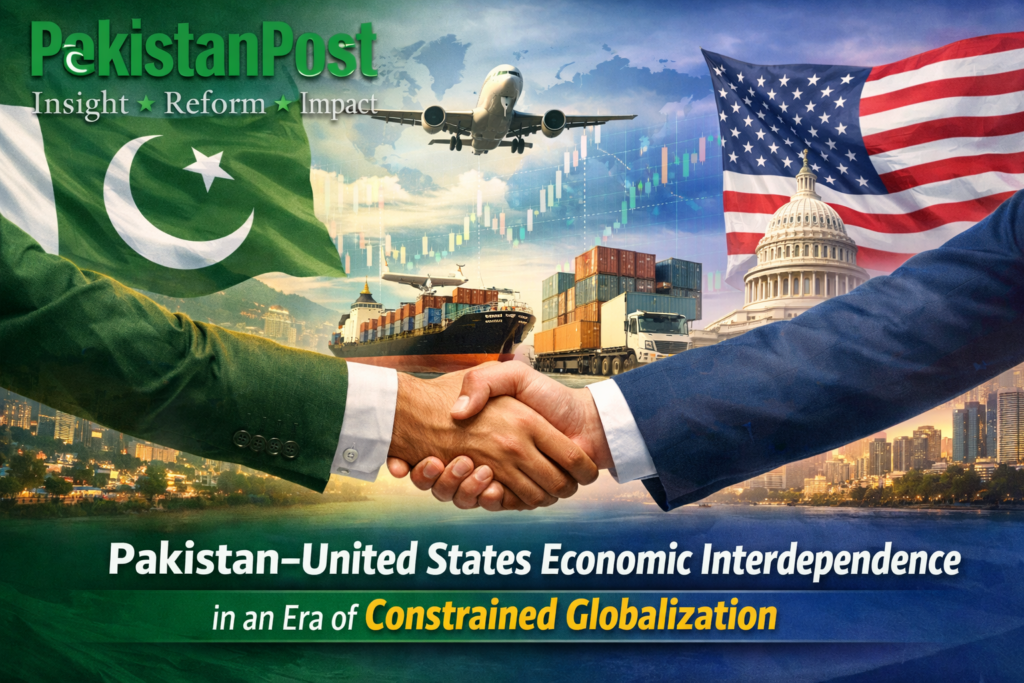
The economic relationship between Pakistan and United States has historically oscillated between strategic alignment and episodic disengagement, yet beneath its geopolitical fluctuations lies a persistent and structurally significant economic interdependence. In 2026, this relationship has acquired renewed relevance, not as a function of ideological convergence, but as a pragmatic necessity shaped by trade asymmetries, institutional financial linkages, and macroeconomic vulnerabilities within Pakistan’s economic architecture.
At the core of this engagement lies trade, which continues to function as the most stable pillar of bilateral economic interaction. The United States remains Pakistan’s largest export destination, with exports reaching approximately 5.6 billion dollars in 2024, dominated by textiles, apparel, and value-added cotton products. Two-way trade has steadily expanded, projected to exceed 8 billion dollars in 2025, reflecting resilience despite global supply chain disruptions and shifting trade regimes. This asymmetrical trade pattern, wherein Pakistan maintains a surplus with the United States, provides critical foreign exchange inflows that partially cushion external account pressures. However, this concentration also exposes structural fragility, as Pakistan’s export competitiveness remains narrowly anchored in low value manufacturing with limited technological diversification.
Investment flows further reinforce this interdependence, though their magnitude remains modest relative to potential. The United States has consistently been among the largest sources of foreign direct investment in Pakistan, particularly in sectors such as energy, consumer goods, and information technology. Institutional frameworks such as the Trade and Investment Framework Agreement provide a formal mechanism for dialogue, yet the absence of a comprehensive free trade agreement constrains the depth of integration. American investment behavior reflects a cautious calculus, shaped by concerns over regulatory unpredictability, governance deficits, and macroeconomic volatility, all of which have been repeatedly flagged in international financial assessments.
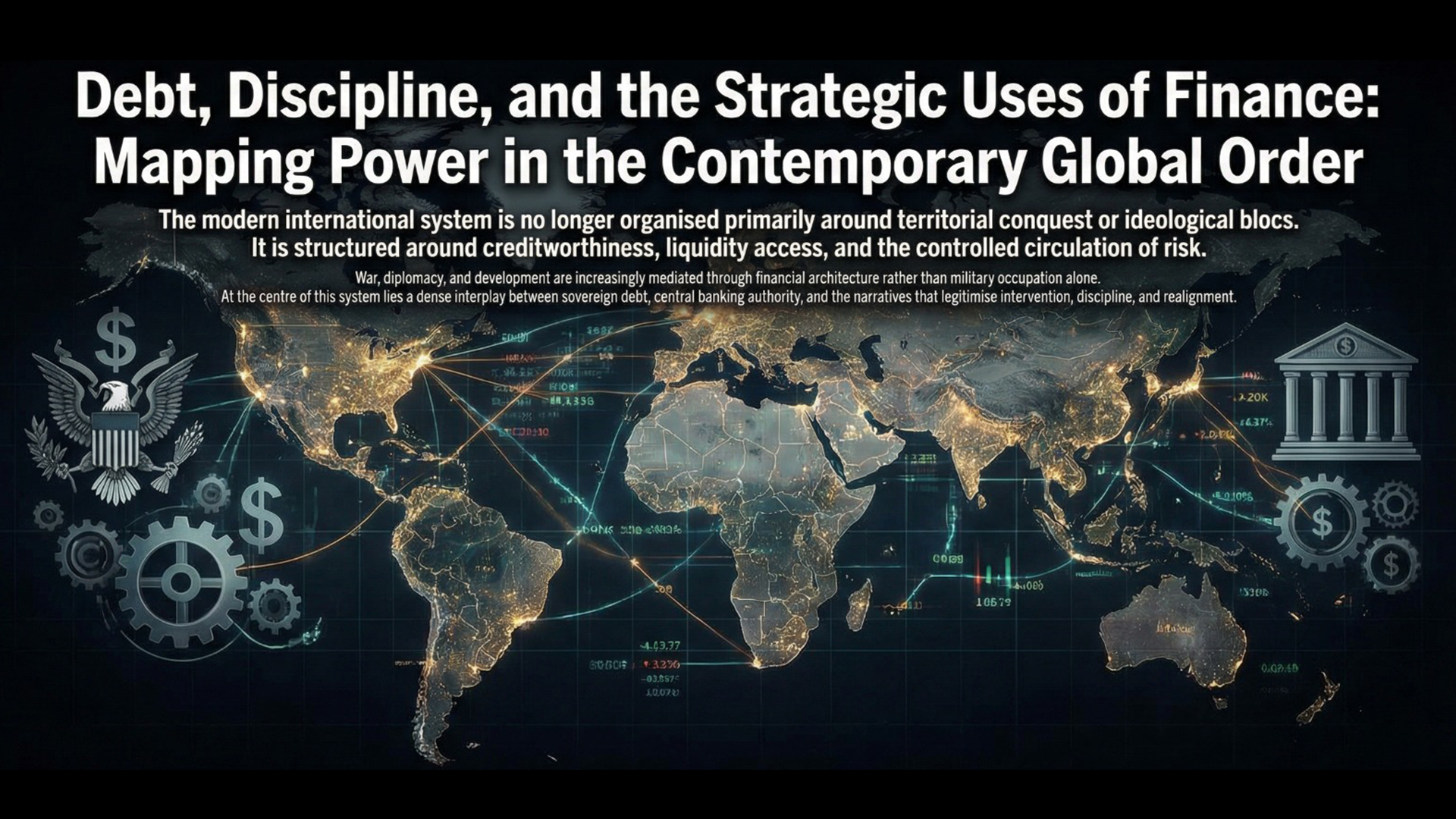
The most consequential dimension of Pakistan’s economic engagement with the United States, however, operates through multilateral financial institutions, particularly the International Monetary Fund and the World Bank. These institutions, where the United States retains significant influence, constitute the backbone of Pakistan’s external financing architecture. The ongoing 7-billion-dollar IMF Extended Fund Facility underscores the extent to which Pakistan’s macroeconomic stability is contingent upon compliance with externally prescribed reform frameworks. Recent developments indicate a staff level agreement that could unlock an additional 1.2 billion dollars, contingent upon fiscal discipline and monetary tightening Similarly, the World Bank has approved substantial financing packages aimed at stabilizing public finances and supporting structural reforms, including a 700-million-dollar initiative targeting fiscal resilience.
These financial flows are not merely transactional; they embed a regime of policy conditionality that shapes Pakistan’s economic governance. Monetary tightening, subsidy rationalization, tax reform, and exchange rate flexibility are not domestically endogenous choices but externally incentivized imperatives. The State Bank’s maintenance of relatively high interest rates in response to inflationary pressures reflects adherence to IMF prescriptions designed to anchor expectations and stabilize the currency. While such measures have contributed to short term stabilization, including a current account surplus of 0.5 percent of GDP in fiscal year 2025), they also impose contractionary pressures on domestic growth and industrial expansion.
The historical trajectory of US Pakistan economic relations reveals a pattern of episodic intensification aligned with geopolitical priorities, followed by periods of relative disengagement. During the Cold War and the post 9 11 era, economic assistance and preferential access were often linked to security cooperation. In contrast, the contemporary phase is characterized by a shift toward market driven engagement, where trade and investment are less contingent upon strategic alignment and more reflective of economic rationality. This transition has reduced volatility but also diminished the scale of direct financial assistance, thereby increasing Pakistan’s reliance on multilateral mechanisms.
In the post pandemic and post inflationary global environment, new challenges have emerged that complicate this relationship. Global inflationary pressures, driven by energy price volatility and supply chain disruptions, have exacerbated Pakistan’s import bill, particularly in energy dependent sectors. The depreciation of the Pakistani rupee, while theoretically enhancing export competitiveness, has been offset by structural inefficiencies, including high input costs, limited technological upgrading, and weak institutional capacity. Consequently, the benefits of currency adjustment have not translated into a significant expansion of export diversification.
Moreover, shifts in US economic policy, particularly the reconfiguration of global supply chains and the emphasis on domestic industrial policy, have implications for Pakistan’s export prospects. The increasing adoption of friend shoring and near shoring strategies may marginalize geographically distant and structurally constrained economies unless they integrate into higher value segments of global value chains. Pakistan’s current export profile, heavily concentrated in textiles, faces competitive pressure from countries that have successfully moved up the value chain through technological integration and human capital development.
The question of strategic dependency looms large within this framework. Pakistan’s reliance on the United States as a primary export market and on US influenced financial institutions for external financing creates a dual dependency that constrains policy autonomy. This dependency is not absolute, but it is sufficiently significant to shape macroeconomic decision making. The conditionalities associated with IMF programs, while necessary for stabilization, limit the scope for heterodox policy experimentation and reinforce a cycle of external reliance.
Yet, avenues for diversification do exist, albeit requiring structural transformation rather than incremental adjustment. Expanding export markets beyond traditional destinations, investing in technological upgrading, and enhancing human capital are essential for reducing vulnerability. Similarly, diversifying sources of investment and financing can mitigate concentration risks. However, such diversification must be pursued with strategic coherence, ensuring that new partnerships complement rather than destabilize existing economic linkages.
Pakistan’s economic engagement with the United States in 2026 is defined by a complex interplay of trade dependence, financial intermediation, and structural constraints. It is neither a relationship of subordination nor one of parity, but rather a pragmatic alignment shaped by mutual, albeit asymmetrical, economic interests. The challenge for Pakistan lies not in disengaging from this relationship, but in recalibrating it through internal reform, diversification, and strategic foresight, thereby transforming dependency into interdependence and vulnerability into resilience.
A Public Service Message