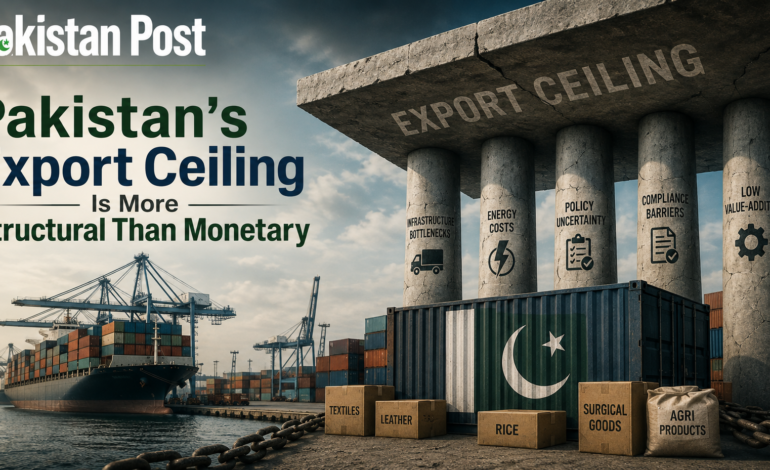
Pakistan’s Export Ceiling Is More Structural Than Monetary

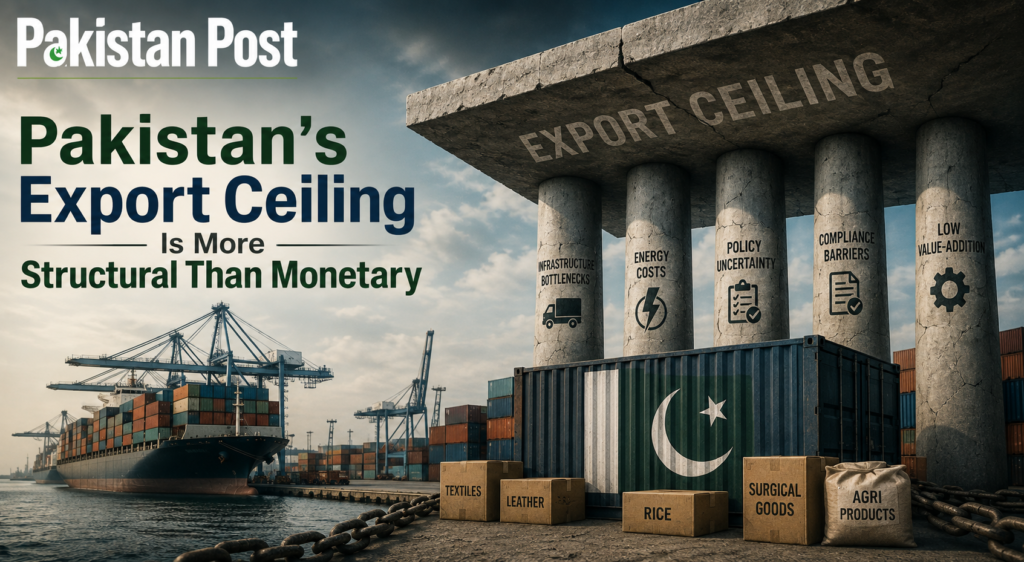
Pakistan’s recurring belief in the exchange rate as an export strategy has survived far more evidence than it deserves. Whenever the rupee weakens, policymakers expect exporters to become more competitive, factories to expand, foreign buyers to increase orders and the trade deficit to narrow. Yet the historical record suggests that currency adjustment can change the price at which Pakistan sells, without fundamentally changing what Pakistan is capable of producing. The distinction is critical. A cheaper currency can compensate temporarily for inefficiency, but it cannot manufacture engineering capability, create internationally accredited laboratories, build pharmaceutical research capacity, secure reliable electricity, establish global brands or persuade sophisticated buyers to shift procurement networks.
Pakistan therefore faces an export problem that is less about the nominal exchange rate than the productive architecture behind it. The country has repeatedly demonstrated that it can produce competitively when the product, market and policy environment are favourable. It has a substantial textile base, established surgical instrument clusters, an expanding information technology industry, a growing pharmaceutical sector, internationally recognised sporting goods, agricultural commodities and pockets of engineering competence. Yet these capabilities remain insufficiently connected to a broader industrial upgrading process. Merchandise exports and services exports remain modest relative to the size of the economy, while exports of goods and services have remained around a tenth of GDP, far below what would be required for a durable export led growth model. The World Bank has identified high tariffs, cumbersome regulation, expensive energy and logistics, weak trade finance and limited market integration as structural constraints. (World Bank)
The immediate policy implication is uncomfortable but important. Pakistan should stop treating export competitiveness as a single variable. The relevant question for the state is not whether the rupee is sufficiently competitive, but whether an exporter can transform imported inputs, domestic labour, capital, technology and managerial capability into a product that meets international specifications at a predictable cost and reaches a foreign customer on schedule. Currency is only one component of that equation.
Textiles provide the clearest illustration. Pakistan has sophisticated spinning, weaving, processing and apparel capabilities, yet its comparative advantage remains concentrated disproportionately in established categories rather than in the highest value segments of global fashion, technical textiles, performance fabrics, specialised apparel and branded consumer products. The textile sector still accounts for the majority of merchandise exports, with the Pakistan Economic Survey 2024 to 25 reporting textiles at about 55 percent of total exports. Knitwear, bedwear and ready made garments have benefited from stronger volumes and pricing, while non traditional exports including information technology services, pharmaceuticals and engineering goods have shown encouraging expansion. (Finance Division)
The problem is not that Pakistan should abandon textiles. It is that textiles must become an industrial platform rather than an export destination. Firms need access to advanced machinery, synthetic fibres, technical textile technologies, automated cutting, digital design, product development and international retail networks. The state should measure progress not merely by export value but by the share of exports generated from higher value products, the number of firms selling directly to international brands, the domestic value added per worker and the proportion of production meeting recognised environmental and social compliance standards.
That approach would also expose a weakness in conventional export incentives. Tax rebates, subsidised credit and energy concessions can preserve an existing exporter, but they do not necessarily create a more capable exporter. Public support should therefore become conditional on measurable upgrading. A firm receiving preferential financing or fiscal support should demonstrate investment in machinery, certification, workforce training, product development, energy efficiency or entry into new markets. Incentives should expire unless productivity and export performance improve.
Engineering goods require an even more deliberate intervention. Pakistan has engineering firms capable of producing automotive components, industrial equipment, electrical products, surgical equipment and specialised machinery, but these capabilities remain dispersed and insufficiently integrated into global supply chains. The challenge is not simply the absence of factories. It is the absence of a dense ecosystem connecting component manufacturers, design houses, testing facilities, universities, original equipment manufacturers, financial institutions and export markets.
This is where industrial policy needs to become more precise. Rather than protecting entire sectors through broad tariff walls, the state should identify specific products in which Pakistani firms can realistically reach global competitiveness within five to seven years. Each product should receive a productivity benchmark covering unit cost, defect rates, energy consumption, delivery reliability, certification and export penetration. Protection should be linked to a credible timetable for exposure to international competition. Without such discipline, protection becomes a permanent substitute for productivity.
Pharmaceuticals present a different version of the same problem. Pakistan possesses a sizeable domestic pharmaceutical industry, but its global position remains limited, with exports concentrated in generic medicines and a relatively narrow range of markets. The Trade Development Authority of Pakistan has itself identified infrastructure, testing and certification, technology and input availability as constraints affecting international competitiveness. (TDAP)
The strategic requirement is therefore not simply to export more medicines. Pakistan needs internationally credible pharmaceutical manufacturing infrastructure. Regulatory laboratories should be equipped to provide internationally recognised testing. Firms should be encouraged to obtain certifications required by demanding jurisdictions. Public policy should facilitate technology licensing, joint ventures, contract manufacturing and research partnerships. Universities and pharmaceutical companies should be connected through applied research programmes directed at formulations, biosimilars, active pharmaceutical ingredients and specialised therapeutic products. The objective should be to move selected companies from generic production towards technologically differentiated products and regulated markets.
Information technology demonstrates why the currency argument is incomplete. Pakistan’s ICT export earnings reached a record $4.6 billion in fiscal year 2025 to 26, an increase of 20.6 percent, according to official reporting, with the sector generating a services trade surplus of $3.9 billion. (Associated Press of Pakistan) This expansion has occurred despite weaknesses in the wider industrial environment and illustrates the power of skills, global demand, relatively low physical capital requirements and international connectivity.
But services exports have their own ceiling. Pakistan cannot build a durable technology export industry around low cost software labour alone. The next stage must involve software products, cybersecurity, financial technology, enterprise platforms, artificial intelligence services, cloud operations, engineering design and specialised business process services. The strategic objective should be to increase revenue per skilled worker rather than merely increase the number of workers employed in outsourcing.
This requires a different policy architecture from conventional industrial support. Technology exporters need predictable internet infrastructure, reliable international payment channels, intellectual property protection, data governance compatible with major markets, research incentives and access to global venture capital. Commercial diplomacy should also be used to establish technology partnerships rather than merely organise trade exhibitions.
Processed food represents another underexploited opportunity. Pakistan possesses agricultural scale, climatic diversity and established commodity exports, yet a substantial share of its agricultural potential remains captured at the raw commodity stage. Rice, fruits, vegetables, meat and dairy products can generate substantially greater foreign exchange when converted into branded, packaged, traceable and certified products. The obstacle is not agricultural output alone. It is cold chain infrastructure, food safety certification, packaging technology, quality consistency, traceability and market access.
A national export strategy should therefore connect agricultural policy to industrial policy. Export oriented food clusters should receive common testing laboratories, cold storage, packaging facilities, certification support and logistics infrastructure. Foreign missions should maintain market intelligence on supermarket requirements, sanitary standards, consumer preferences and import regulations. Pakistan should compete for shelf space, not merely bulk commodity orders.
Surgical instruments offer an instructive lesson in the danger of remaining trapped inside subcontracting. Sialkot has demonstrated that Pakistani firms can develop specialised manufacturing competence over generations. Yet the transition from contract production to proprietary design, precision engineering, medical technology and international branding requires capabilities that individual small firms cannot easily finance. A cluster strategy could create shared laboratories, metrology centres, design facilities, intellectual property assistance and export marketing platforms. The state should not attempt to replace private enterprise. It should provide the common infrastructure that makes sophisticated private enterprise commercially viable.
The financing system requires equal attention. Exporters cannot upgrade machinery, develop products or enter new markets when working capital is expensive or uncertain. Conventional bank lending often favours collateral rather than export potential, leaving smaller manufacturers disadvantaged. Pakistan needs a more sophisticated export finance architecture in which banks evaluate verified purchase orders, receivables, production capacity and export histories alongside conventional collateral. Export credit guarantees should be expanded for credible small and medium enterprises, while financing for technology acquisition should carry longer maturities than ordinary working capital facilities.
Tariff policy is equally consequential. Pakistan has historically used tariffs both for revenue mobilisation and industrial protection. The result has often been an inverted incentive structure in which exporters face expensive imported machinery, intermediate inputs and components while domestic firms remain protected from competition. The World Bank’s recent assessment argues that tariff reform is necessary but insufficient, and calls for a market determined exchange rate, stronger trade finance, better logistics, digital infrastructure and deeper trade agreements. (World Bank)
The strategic answer is not indiscriminate tariff reduction overnight. It is predictable tariff rationalisation tied to industrial objectives. Capital goods, advanced components and productive intermediate inputs required for export manufacturing should face lower and more stable duties. Finished products should progressively receive greater competitive exposure. The tariff schedule should be evaluated through an export competitiveness lens rather than treated principally as a revenue instrument.
Trade facilitation is another area where Pakistan has already demonstrated that institutional reform can produce tangible gains. The Pakistan Single Window has integrated customs, banks and other regulatory agencies into a digital platform, allowing traders to submit standardised information through a single entry point. Its electronic certificate of origin system has reduced reliance on physical paperwork, while digital processing has improved transparency and shortened administrative procedures. (Pakistan Single Window) The platform reported that Pakistan’s trade facilitation score improved from 57 percent to 71 percent and estimated annual transaction cost savings at about $430 million. (Pakistan Single Window)
The lesson for policymakers is that export reform should increasingly be data driven. The state now has an opportunity to construct an integrated export intelligence system linking customs declarations, electricity consumption, tax records, banking flows, certification data, shipping information and destination markets. Properly governed, such a system could identify promising firms before they become major exporters, detect productivity constraints and determine whether public incentives actually generate additional exports.
Commercial diplomacy must then become more operational. Embassies should not function principally as ceremonial platforms for trade delegations. Economic sections should maintain sector specific intelligence on procurement cycles, tariff barriers, certification requirements, competitor pricing, government tenders, private buyers and emerging supply chain opportunities. A Pakistani engineering firm seeking entry into a Gulf infrastructure supply chain requires different diplomatic support from a pharmaceutical company seeking regulatory approval in Africa or a software company seeking enterprise contracts in Europe.
The institutional question is therefore larger than export promotion. Pakistan needs an export industrial command architecture capable of identifying strategic sectors, assigning measurable targets, coordinating ministries and agencies, and terminating programmes that fail. The proposed mechanism should include Commerce, Finance, Industries, Energy, Science and Technology, the State Bank, customs authorities, standards institutions, provincial governments and private sector representatives. Its performance should be reviewed quarterly against hard indicators rather than policy announcements.
Those indicators should include export growth by product, domestic value added, labour productivity, energy intensity, certification acquisition, market diversification, number of new exporting firms, survival of new exporters, technology imports, foreign investment partnerships and movement into branded products. A sector that receives public support but fails to improve these indicators should lose preferential treatment.
This matters beyond the balance of payments. Export sophistication is a strategic capability. A country that cannot manufacture precision components, process pharmaceuticals to international standards, produce advanced materials, develop software products or supply sophisticated food systems remains dependent on external suppliers for technology and foreign exchange. That dependence constrains fiscal autonomy, limits defence industrial resilience and weakens the state’s bargaining position during external shocks.
Pakistan’s export ceiling is therefore not a consequence of an insufficiently weak currency. It is the product of an industrial system that has learned to survive volatility without consistently converting survival into capability. Repeated depreciation can temporarily increase the rupee value of exports, but it cannot substitute for productivity. Protection can preserve factories, but it cannot create internationally competitive firms. Subsidies can prevent closures, but they cannot establish global brands. Trade missions can generate meetings, but only standards, reliability, technology and price can generate durable procurement relationships.
The strategic objective should consequently shift from export promotion to export capability formation. Pakistan needs fewer generic incentives and more sector specific performance contracts. It needs fewer ceremonial trade missions and more commercial intelligence. It needs fewer permanent protections and more disciplined technology acquisition. It needs laboratories that can certify products before foreign regulators reject them, finance that rewards export potential rather than collateral alone, logistics that make delivery predictable, energy policy that treats industrial reliability as an economic security requirement, and commercial diplomacy that opens procurement channels rather than merely markets.
The decisive measure of success should not be whether Pakistan exports more next year. It should be whether Pakistani firms become harder to replace in global supply chains. That means moving from volume to value, from subcontracting to design, from commodities to processed products, from generic medicines to regulated pharmaceuticals, from software labour to intellectual property, from textile capacity to brands and technical products, and from isolated industrial clusters to integrated production ecosystems. Once that transformation begins, currency competitiveness will become useful for what it should have been all along, an amplifier of productive strength rather than a substitute for it.
A Public Service Message